
The Operator’s Reset
About 97 min read
The argument
Funnel Futurist · Personal Operating System · Last updated: August 2026
We constantly attribute to character what is actually being produced by environment.
START HERE: WHAT THE OPERATOR'S RESET IS
If you are reading this, something is probably working
You built something. It pays you. You are not sitting in an office asking permission to take a Tuesday off.
And somewhere in getting that freedom, you lost the structure that came with it.
Nobody tells you when to start. Nobody notices when you drift. The calendar has no shape except the one you keep failing to give it. And the reason that matters is not discipline, it is that the structure you removed was doing work you did not see it doing.
What that actually looks like day to day
You struggle to focus consistently, and it is worse on the days the work is hardest.
Basic things get missed. Not important things, usually. Renewals, follow-ups, the thing you said you would send.
Unfinished obligations sit in the back of your mind all day, taking up room, none of them close enough to the front to actually get done.
The business always feels one step away from finally giving you the space to handle your personal life, and that step never arrives. There is always another launch, another hire, another fire.
You stay reactive. You are good at putting out fires, which is exactly the problem, because being good at it means you never stop long enough to ask why the same fire keeps starting.
And you never get enough distance to look at the problems that have been repeating for three, six, nine, twelve months. You know they are there. You could probably name two of them right now.
Your time gets away from you. At the end of a week you could not honestly say how productive you were, only that you were busy.
You have no reliable way to see the personal behaviors that determine how well you work. Sleep, movement, how you start the day, what you do when the work gets hard.
And you may have no written answer to four questions that quietly govern everything else. What actually happened in this company. Where it is going. Why any of that matters. And what standards you will hold to on the way.
Those four have names, and I will use them later, and the names are the least useful part. What matters is what each one does.
Almost nobody thinks they are operating at their ceiling
This is not a document for somebody whose life is collapsing.
It is for somebody who knows that their environment, their attention, their finances, their clarity, their time allocation, or their personal consistency is creating drag they do not have to be carrying.
If you already believe that, you can skip the rest of this argument and start at SOP 1. The reading routes below say how.
Why these problems get worse rather than staying flat
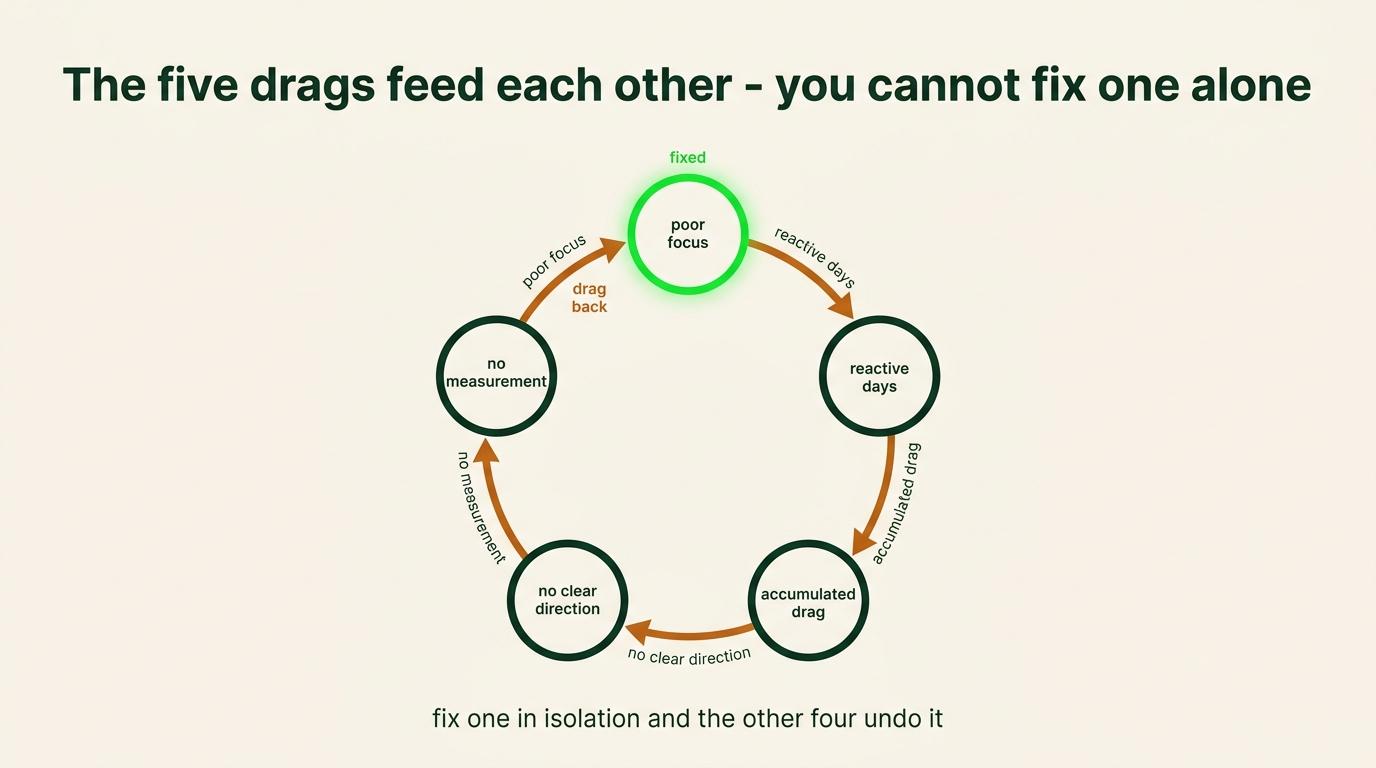
None of these sit still. Each one produces a second problem that is harder to see than the first.
Focus. When you cannot hold attention on hard work, you reach for easier stimulation the moment the work gets difficult. And modern life has made that available at every second of every day, in your pocket, at higher quality than at any point in history.
So the reach becomes a habit, and the habit lowers your capacity to repeat the difficult behavior that the goal actually requires. You do not lose the ability all at once. You lose the reps.
Clutter. Unresolved subscriptions, open loops, dead tools, forgotten commitments and unpaid attention debts accumulate, and every one of them was originally somebody solving a problem. The tools you bought to fix things become a thing that needs fixing. The attempted solution becomes another layer of the problem.
Shared context. If you have a business partner and no shared picture of what happened and where you are going, you both start interpreting each other's behavior without knowing what is driving it. You see them running around the far side of the deck and conclude they are being irrational.
They are responding to a problem you cannot see. Two people start making decisions from two versions of reality, and neither knows it.
Time. Without measurement you reach the end of the week having moved at a thousand miles an hour with no idea what you accomplished, what interrupted you, what should have been delegated, or what did not need doing at all. And you cannot fix an allocation problem you cannot see.
Maintenance. Without a system that holds, you improve for a stretch and then fall back to the previous floor the first time the business gets hard. Which it will. The gains are real and they are not load-bearing.
The reason this document exists is that none of those are separate problems. Each one makes the next one worse, and fixing any one of them alone gets undone by the other four.
What the other side looks like
You can focus without renegotiating with yourself every few minutes, because the negotiation stopped being available.
You can see your financial reality, recover money you were losing without knowing it, and clear the technical and personal debt that accumulated while you were busy.
You know what happened in the business, you and your partner agree on where it is going, and you both know what standards govern the trip.
You can see how your time is actually spent, which makes delegation a decision rather than a guess.
And you have habits that hold the progress in place when the business gets difficult.
Two things you are actually after, and you need both
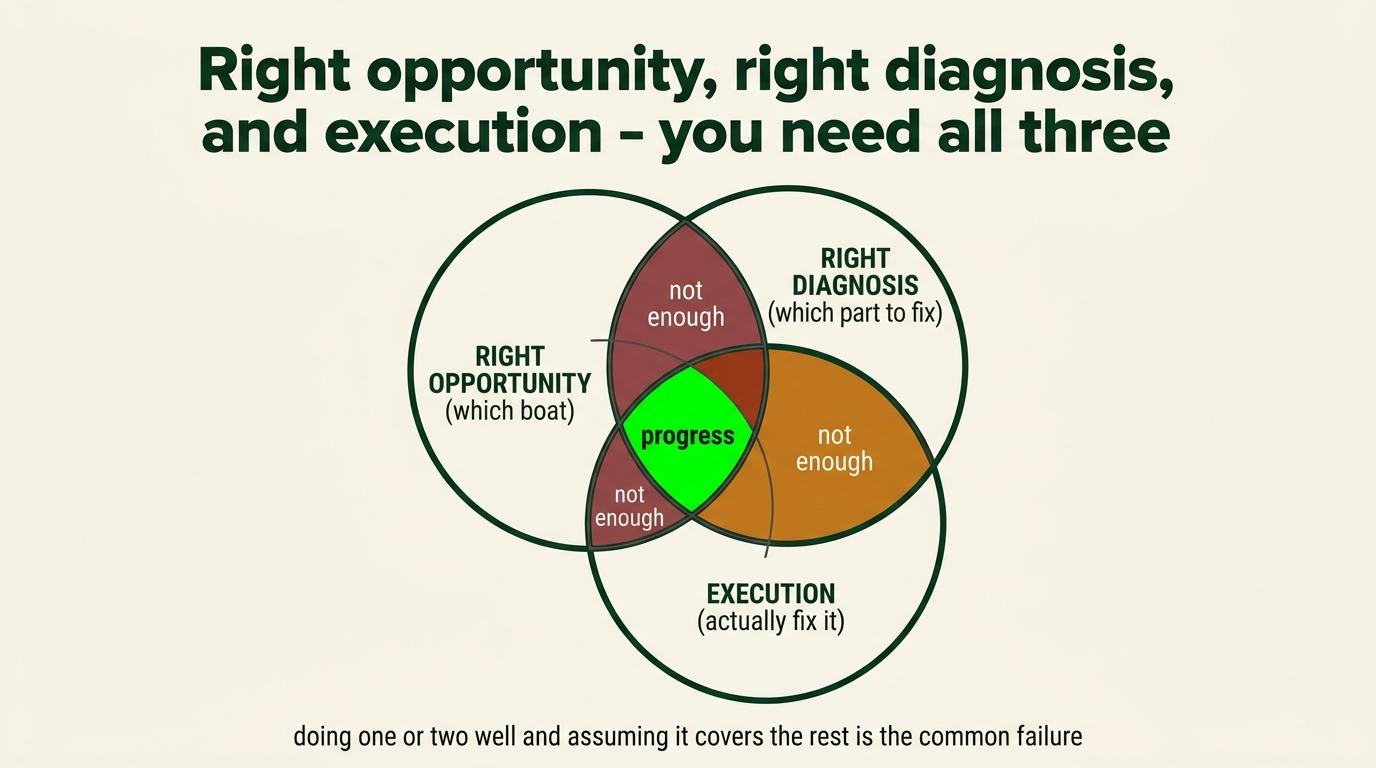
Success comes from being in the right opportunity, correctly identifying the constraint, and doing the right work in the right order.
Satisfaction comes from ending the day knowing you gave your best effort to the work that actually mattered.
Those are different, and a system that produces one without the other fails.
Think of it as a boat. The opportunity is which boat you are in. Constraint diagnosis tells you which part of it needs repair. Execution determines whether you actually fix it and move.
Being in the right boat is not enough. Rowing hard is not enough. You have to row hard on the right thing, and most people who are failing are doing one of the three well and assuming that covers the other two.
What this actually is, and what it is not
This is not mindset training.
Your mindset will fluctuate. Your energy will fluctuate. You will have days where you are sharp and days where you are not, and no amount of reading changes that.
So the design goal is an environment and an operating system that make the correct action more likely regardless of which day it is.
Systems beat sacrifice
Sacrifice implies you still want the thing you are giving up, and that you are overriding the wanting with force.
That works, and it works for a while but it is expensive on your mental state every single time.
A focus system removes the recurring negotiation.
The distracting option is either not available or not attractive enough to compete, so there is nothing to override.
You can keep grinding yourself down through willpowe or you can put that same effort into a system that points it at what you actually want, and stop spending it on the same decision forty times a day.
Every module removes something
This is subtraction, five times. Not five techniques stacked on top of a person who is already carrying too much.
| Focus Stack | Removes the competing stimulus |
|---|---|
| Tech Teardown and Personal CFO | Removes the clutter and the financial fog |
| Post-Mortem, Mission, Vision, Values | Removes the strategic ambiguity |
| Radical Time Tracking | Removes the false beliefs about where time goes |
| Habit System | Removes the recurring daily decision |
In practical terms: you are not being asked to do more. You are being asked to take five things away, in an order where each one makes the next one possible.
The ship, because the order matters
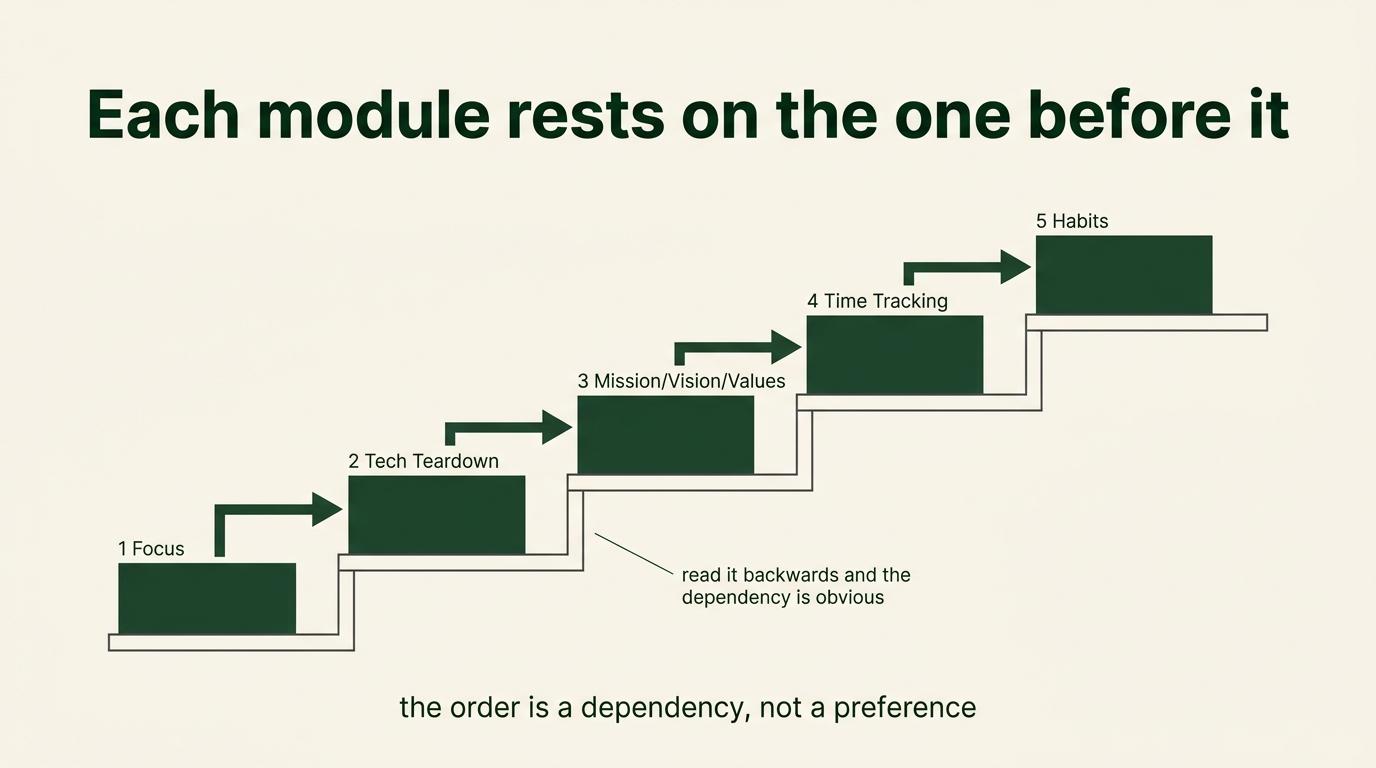
The five modules are a sequence rather than a menu, and the sequence is a claim about what depends on what.
1. The Focus Stack clears the distractions stopping the captain concentrating on the ship at all. Everything downstream needs somebody who can hold attention on something unpleasant for an hour.
2. The Tech Teardown and Personal CFO stop the visible bleeding. Clear the accumulated clutter, find where money and attention are leaking out of the hull.
3. The Post-Mortem and the direction documents let the captains understand how the ship reached this position, agree where it is going, and set the standards for the trip. If there are two of you, this is where you stop steering against each other.
4. Radical Time Tracking shows what the captain is actually doing all day, what does not matter, and what should be eliminated, delegated, automated or handed to somebody else on the crew.
5. The Habit System maintains the operator and installs the recurring behaviors that keep the ship moving when conditions get bad.
Read that backwards and you can see why the order is fixed. You cannot build habits around the right things without measurement. You cannot measure meaningfully without a direction.
You cannot set a direction with fifty open loops running. And you cannot clear open loops if you cannot sit with something difficult for an hour.
Where this sits
Stage: None. This is the first layer of the operating base, underneath every stage
Consumes: An operator who is ready to run the business, whether founder, partner, or a placed teammate
Produces: An operator who can execute consistently. Reduced environmental noise, cleared open loops, an established direction, measured behavior, focus controls, and a recurring cadence
Metric: Completion and adoption of the Reset, integrity of the tracking layers, early consistency
Does not solve: Any stage. Not Attention, not Close, not Succeed. It does not fix the offer, the pipeline, the delivery, or the economics
Feeds back into: Every stage at once, and the FOUNDER FREEDOM rail specifically
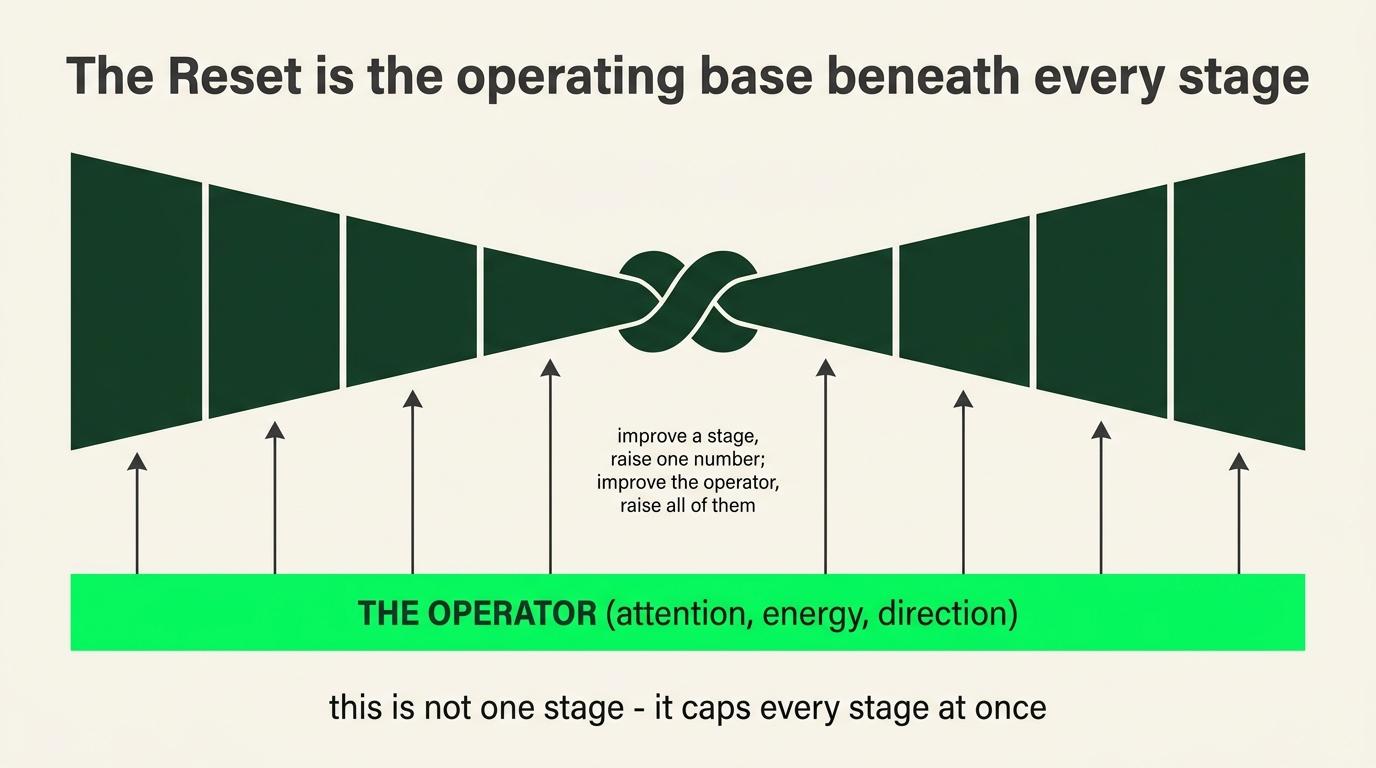
The Bowtie names this directly as a common misplacement. Focus treated as a personal matter, when it is the first layer of the operating base and it caps every stage at once. That is why it belongs in a diagnosis rather than in a conversation about somebody's week.
The relationship, stated plainly. The Bowtie shows how the business produces profitability, stability and freedom, and in what order to build it. This makes the operator capable of executing that roadmap consistently. One is the map. This is whether the person holding it can walk.
It compounds sideways, which is the part people miss. Improving a stage raises one number. Improving the operator raises the output of everything they build, and everything a teammate builds if you hand it to them, including work you have not scoped yet.
Personal first, transferable second
The Reset is written largely from the perspective of a founder, because that is where most of it came from. The operating model is not founder-specific.
It applies anywhere somebody's personal consistency materially affects an outcome. Founders, salespeople, CSMs, operators, VAs, freelancers, anybody working with meaningful autonomy and not much external structure holding them to it.
It also transfers into leadership, with one order of operations that matters. Get your own system working before trying to install one for somebody else. A rollout does not repair a weak system, it multiplies it, and the team will read a ritual the leader does not keep for exactly what it is.
A leader can model consistency, help somebody build their own operating cadence, and create accountability deliberately. None of that means inheriting somebody else's habits or turning a Personal OS into employee surveillance. Personal habits, personal data and raw telemetry stay private unless the person chooses to share something specific, for a stated reason.
Personal first. Transferable second. Never surveillance.
The end of this document covers when to rerun the Reset on yourself and when to hand it to somebody else.
What this eventually becomes
Every module here produces a data source, and together they become the first personal layer inside your Command OS.
Financial reality. Decisions and their reasoning. Time allocation. Habits and consistency. Commitments. Assumptions.
The rest of the Command OS shows you the business. This layer shows you your relationship with the business, which is a different question and usually the one nobody can answer.
The value is that it is raw rather than remembered. Not the story you tell yourself about how the month went. The record.
Later, that record can be read alongside the business constraints, so the question stops being "am I working hard enough" and becomes "is where my time actually goes matching what the business actually needs."
None of that is taught here and none of it gets connected here. Build the five systems. The visibility layer comes after Orientation, and it reads what these produce.
What this document is
This is the argument. The five SOPs are the execution.
Everything in here explains why the system works the way it does, what it cost me to find out, and how the five pieces connect. None of it tells you what to click.
The SOPs do that, and they are deliberately lean, because a step-by-step document that keeps stopping to persuade you is a document nobody finishes.
So if you are ever partway through an SOP and thinking, why am I doing this, come back here. Anywhere here. It is one argument rather than five, and the section you need is probably not the one matching the SOP you were reading.
Definition of Done
Facts. You will understand why focus breaks, why subtraction is the operation rather than addition, why systems outperform willpower, why direction has to precede effort, why measurement has to precede change, and why load has a ceiling.
Feelings. Consistency should start reading as a design problem with a solution rather than a character flaw you are stuck with.
Functionality. You will know which of the five SOPs to run first, and why that order rather than any other.
How to use this document
This is the context layer. The five SOPs are the execution layer.
This document explains the reasoning behind the system, how the pieces connect, what we learned building it, why the sequence exists, where previous versions failed, and how to think when something does not fit neatly into an SOP.
The SOPs explain what to do and how to do it. If you already understand the reasoning and just need to implement, use them.
The depth here is deliberate, partly because this is also the canonical knowledge source for AI support agents. An AI SOP, a CSM copilot, or any internal assistant should be able to reference it when somebody asks why something works the way it does, how two parts relate, what to do with an edge case, or what reasoning produced a decision.
The SOP tells you what to do. This gives humans and AI enough context to understand why, answer questions, and reason intelligently when the SOP alone is not enough.
If an implementation detail here ever conflicts with a current SOP, the SOP wins for execution. This document remains the source of truth for context and reasoning.
Two ways to read it
Route one, straight to implementation. If you recognise the problem and you already believe the premise, go to SOP 1 and start. The modules are self-contained and each one names what it produces. Come back here when you want to know why something is built the way it is.
Route two, the full argument first. Everything below this is the reasoning, the evidence, the things I tried that did not work, and the reversals. Several years of it.
It is useful when you want more trust in the system before spending a weekend on it, or when you want to adapt it rather than run it.
The second route is not mandatory. The parts exist so you can go get one when you need it, not so you can complete a reading assignment before you are allowed to start.
PART I: WHY PERSONAL PERFORMANCE IS A SYSTEMS PROBLEM
Before the five layers make sense, you need the reason personal performance should be treated structurally at all. Without it, the modules look like five unrelated productivity practices.
We attribute to character what environment produces
One of the biggest lessons I have learned is that we constantly attribute to character what is actually being produced by environment.
We say somebody is focused, or productive, or disciplined, or consistent, or naturally good at following through. A lot of the time what we are actually watching is a person performing inside an environment that makes those behaviors easier, and when the environment changes their behavior changes with it and they conclude something is wrong with them.
The clearest version is somebody who performs extremely well in a corporate environment and assumes that makes them a productive entrepreneur.
They have spent years showing up on time, completing their work, answering messages, hitting deadlines, and operating like a responsible adult, so it is entirely reasonable to expect those traits to travel.
Then they leave, start working from home, and the behavior changes completely. They cannot focus, they procrastinate, they work on things that do not matter, they bounce between projects, and they feel constantly overwhelmed while somehow accomplishing very little.
And they start wondering whether they were ever disciplined in the first place.
They did not become a different person. They entered a completely different environment with different stimuli, different stakes, different incentives, different accountability, and a different relationship with work entirely.
Inside a company the structure already existed around them, with a defined role and recurring meetings and managers and deadlines and coworkers and working hours and social expectations and a salary that arrived whether one particular day was phenomenal or mediocre.
Entrepreneurship inverts almost all of it, because the structure disappears while the stakes go up.
You are now responsible for deciding what matters, deciding when to work, creating the deadlines, enforcing the deadlines, directing the work, evaluating the work, and living with the financial consequences when the work produces nothing. Unless you win, you do not make money.
There is no recurring salary protecting you from a bad month, no manager creating urgency on your behalf, and no existing machine telling you what the next highest-leverage action is.
You are the captain, and you are also the person who has to build the navigation system, maintain the engine, watch the weather, choose the destination, and keep the ship moving while everyone on the internet is trying to steal your attention.
Which is why I go so hard on personal structure. Not because everybody needs to become a monk, but because for a lot of us there is no external structure coming to save us.
The three forces competing for your attention
When focus collapses it is usually getting pulled apart across three layers, and knowing which one is actually the problem changes what you should do about it.
Your biological state. Sleep, energy, hunger, illness, physical discomfort, caffeine, and anything else affecting your basic ability to regulate attention.
Your psychological state. Stress, anxiety, uncertainty, conflict, financial pressure, unresolved problems, and all the other material occupying mental space even when it is nowhere near the screen in front of you.
Your environmental state. Physical location, devices, applications, notifications, people, sounds, routines, visual cues, and every behavior you have repeatedly performed in that location.
They feed each other, which is why single-cause explanations never work.
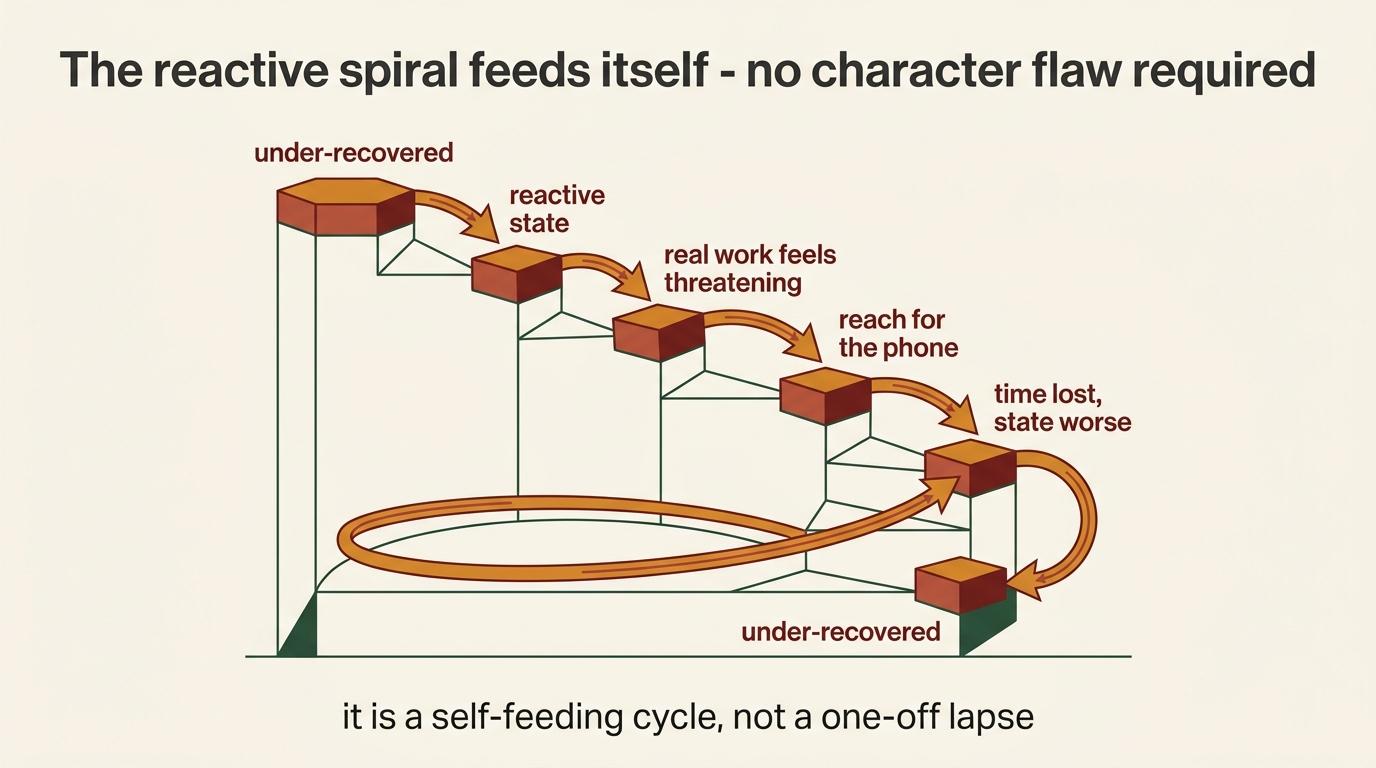
You are sleep-deprived, so you are more emotionally reactive. The reactivity makes the difficult project feel more threatening.
Because it feels threatening you reach for your phone, which provides immediate escape and reinforces the behavior. An hour disappears, you feel worse about yourself, and you return to the work in a more reactive state than you started in.
Now you are tired, distracted, behind, ashamed, and trying to recover the day. That is how the loop builds, and none of the five steps required a character flaw.
This is also the diagnostic. Before reaching for a tool, work out which of the three is actually producing today's version of the problem, because a psychological problem does not respond to a blocker and a biological one does not respond to better planning.
Lack of focus is usually a reactive state
When I cannot focus, I am almost always operating reactively. Something feels uncertain or uncomfortable, my nervous system wants relief, and the response comes out as some version of fight, flight, or freeze.
Fight looks like doing an enormous amount of work that does not matter. Reorganizing things, inventing projects, answering low-priority messages, creating another document. Making progress on something, because seeing movement feels better than sitting with the possibility that the actual important thing might fail.
Flight looks like scrolling, watching videos, checking notifications, eating, opening random tabs, or anything else that temporarily gets you out of the pressure.
Freeze looks like sitting there. Procrastinating, doing nothing meaningful, and getting exhausted purely from the fact that you are supposed to be doing something meaningful.
Productive procrastination sits between them, and it is the most convincing of the three.
You clean your room, you fold clothes, you reorganize the desk, you complete some chore that might genuinely need doing eventually while knowing goddamn well it does not need doing right now. The task gets chosen because it delivers the emotional reward of completion without requiring you to face the thing that currently feels uncertain, rather than because it is important.
The whole system exists to interrupt that before it becomes a full-day spiral.
It is designed to hedge against predictable failure rather than to turn anybody into an optimized machine. What you are installing is a set of guardrails that reduces the number of moments where your future depends on making a perfect decision while tired, stressed, distracted, and reactive.
Why the distraction wins in the moment
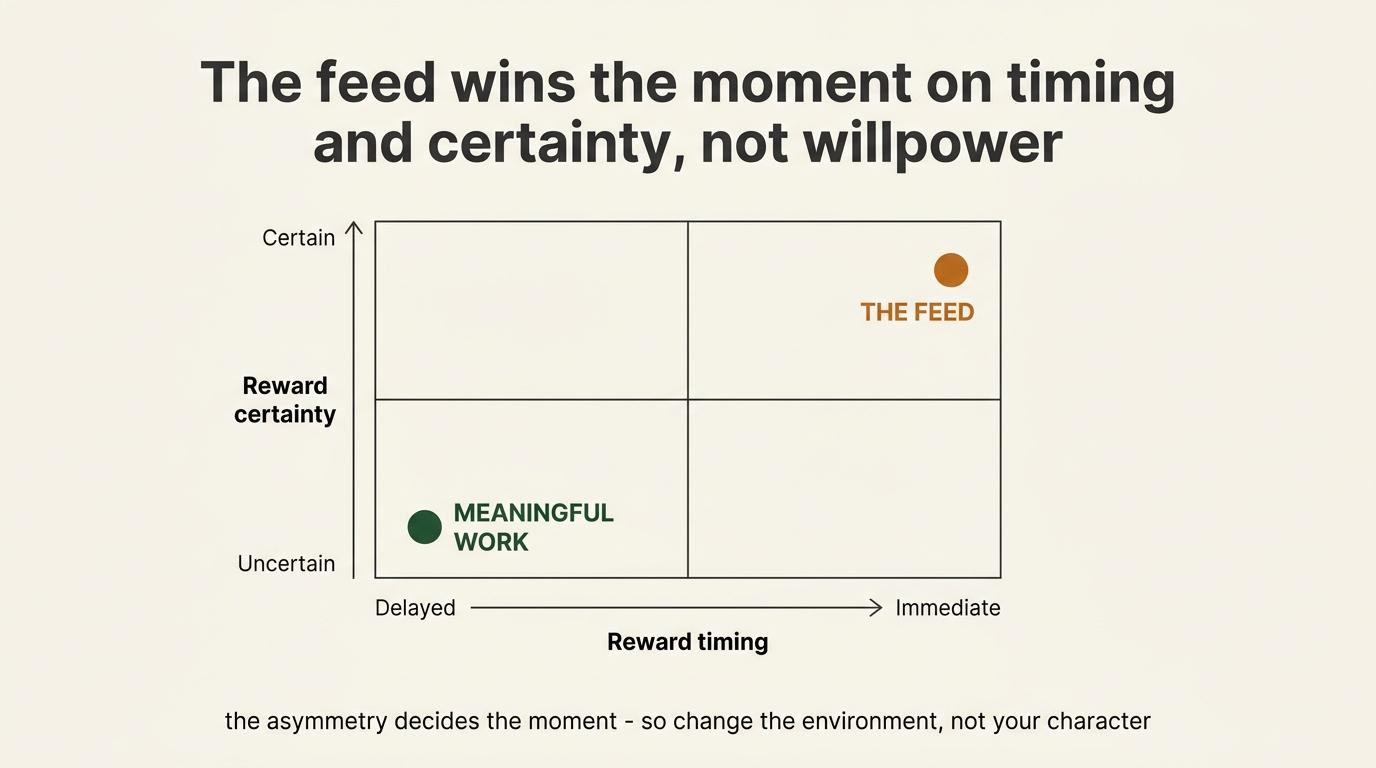
Meaningful work carries uncertainty in a way distraction does not, and that asymmetry is most of the problem.
I do not know whether the ad will work, whether the prospect will buy, or whether the project lands the way I expect, so the benefit of finishing is both delayed and unconfirmed. The feed is the opposite, because the reward is small and short-lived and completely predictable, and I already know what the next few seconds will feel like before I start.
So an uncertain future benefit is competing against a certain immediate one. When the distraction wins, that is a conditioned impulse finding an easy target during a moment of uncertainty rather than evidence of anything about your character.
Which matters mostly because shame makes the loop worse. If I treat a lapse as proof I am lazy, the shame becomes another uncomfortable state I want out of, and the fastest exit from that state is the same behavior I just judged myself for.
And the medium makes it harder than it should be. One of the harder realities of building anything online is that the same medium I use to build it is the one engineered to pull me out of it. I open the phone to talk to a client and I am one tap from every shortcut available, and the same is true the moment I open a browser to work.
The distraction is the workplace itself rather than something arriving into it from outside, and the mechanism underneath it is cues rather than decisions. I see the thing, the sequence fires, and the app is open before any part of me chose to open it.
That is why everything in this system works at the cue level rather than the willpower level. The environment was making the decision, so the environment is what changes.
The driver should not also be the pit crew
There is a reason the driver is not also running the pit stop.
The driver is supposed to drive. Not pull over, climb out, replace the tires, inspect the engine, refill everything, reorganize the team, and then return to the race at full intensity.
There is a team and a system around the driver so that when it is time to perform, nearly all of the driver's attention can go toward performing.
That is what your systems are for. Not because systems are aesthetically pleasing or because organizing your life feels sophisticated, but so you can go hard when going hard matters, with fewer unrelated variables competing for your attention while you execute.
Operating entirely on willpower is stupid.
Anybody performing at a high level for an extended period has systematized significant portions of the bullshit that would otherwise distract them. They build routines, control access, hire support, use defined planning systems, remove decisions, and establish recurring structures that keep running when motivation is low.
Sometimes the guardrail is software, sometimes another person, sometimes a physical location, and sometimes a schedule or a recurring meeting or a checklist. The mechanism matters less than the outcome, which is that the right behavior gets easier and the wrong behavior gets harder.
Success is far less about character than most people want to admit, and far less about permanently wanting it more than everybody else. It correlates much more with the quality of your systems, the environments supporting them, and how consistently those structures reinforce the behavior that produces the outcome.
There are not that many people working ten times harder than you. There are a lot of people operating inside systems that are ten times better than yours.
They may have worked extremely hard for a concentrated period to build those systems, and once the systems existed they kept producing leverage long after the initial effort ended.
The best performers still have to perform. They still run the race, make the decisions, do the work, tolerate discomfort, and adapt when something breaks.
They are just not simultaneously fighting nine hundred preventable battles, and the preparation is what preserves enough mental space to respond intelligently when the genuinely unpredictable problem shows up.
This is not the objectively perfect productivity system for every person on earth, because such a thing would be an idiotic claim. It is the system I developed through years of working online, building companies, selling, managing people, and repeatedly finding out where my own focus breaks.
Steal it on day one, then alter it around your work, your biology, your responsibilities, and your actual life.
Constraints create freedom
A lot of what the SOPs recommend will initially look constraining. Blocking software, removed applications, parental controls, separate working environments, a restricted phone, tracked time, and deliberately eliminated choices.
Constraints are what build a life of freedom, and the point is to constrain the parts of your life that repeatedly steal your attention so you can be free in the parts that actually matter, rather than to make the whole thing rigid.
And you are already constrained.
Constrained by distraction, algorithms, exhaustion, anxiety, environmental cues, notifications, unfinished obligations, and the fact that thousands of extremely intelligent people are financially incentivized to keep you staring at a screen.
So the real question is whether you chose your constraints or inherited them, because they are there either way.
A useful constraint narrows your field of attention, reduces impulsive switching, clarifies priorities, and makes it easier to stay with one thing. Which are the same functional benefits people are usually chasing through brute-force stimulation, except this version gets them by changing the environment around the behavior rather than expecting you to overpower yourself chemically or psychologically every single day.
One operation, five objects
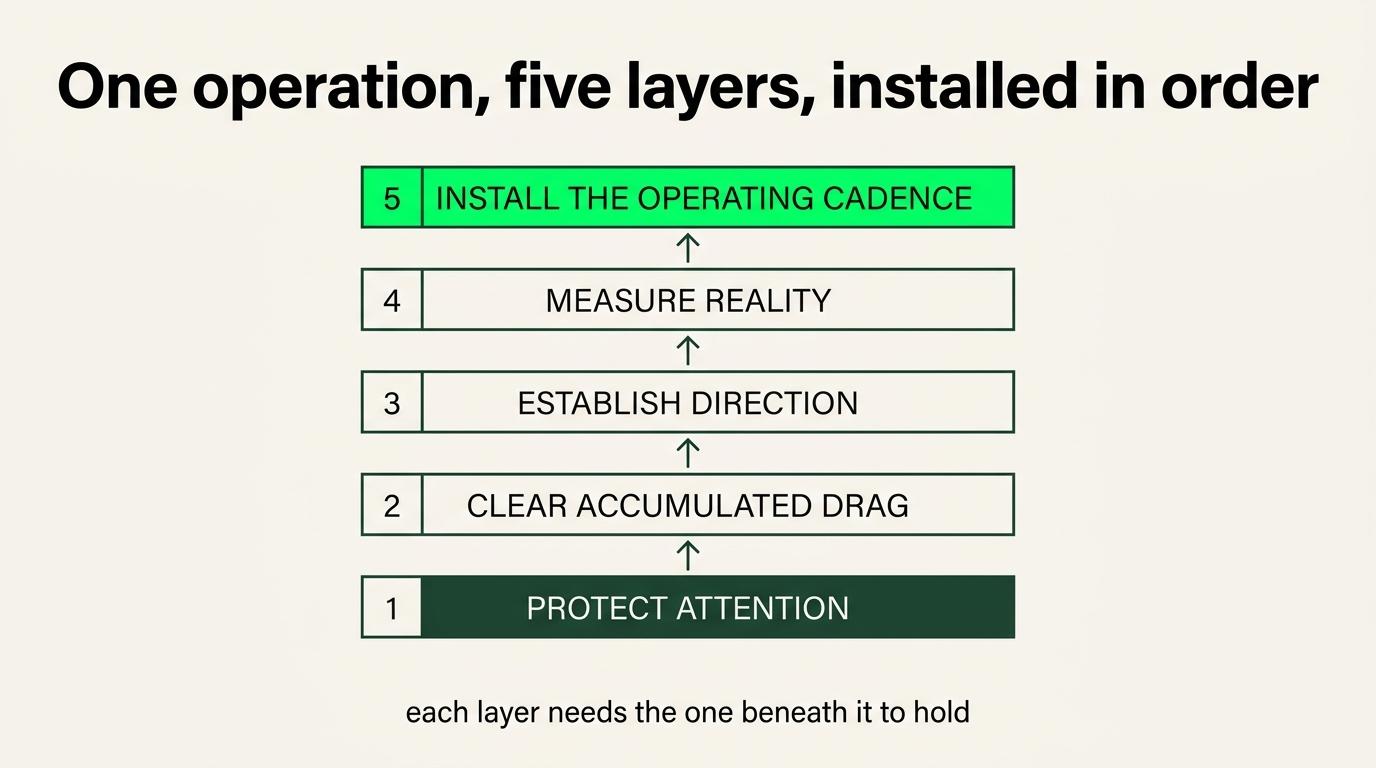
The five SOPs look like five different subjects and they are one operation applied five times.
Focus subtracts stimulus. The things pulling attention away from whatever you decided to do.
The teardown subtracts infrastructure. The tools, subscriptions, open loops, and accumulated obligations nobody has looked at in a year.
The post-mortem subtracts directions. Choosing a mission is mostly the act of eliminating every other thing you could have pointed at.
Time tracking subtracts illusions. Specifically the false beliefs about where your hours actually go, which are always kinder than the truth.
The habit system subtracts the decision itself, by making the recurring part of the day automatic so your judgment goes somewhere that needs it.
Same operation, five objects. Which is why the order matters and why running them in a different sequence produces worse results rather than the same results later.
Clearing infrastructure while getting pulled out of the work every ten minutes does not hold, choosing a direction while still buried in the noise that produced your situation reproduces the noise, and time data means nothing until there is a direction to compare it against. Habits come last because until the other four have run, you do not know which work should even be yours.
That last one costs more than it sounds. A habit built around the wrong task is a well-engineered cage.
I learned the order by doing it wrong. I tried cleaning up our software stack during a stretch where I was getting interrupted constantly and abandoned it a third of the way through, then sat down to write a mission while still inside the mess that produced the situation I was writing about, and by the time I reached habits I had already built two systems around work that should never have been mine.
Build it for the day you are gassed
A system is not proven on your best day. It gets proven on the day you are tired and behind and distracted and stressed and carrying a pile of unresolved open loops.
So do not build for the day you slept perfectly and the inbox is clean and you already know what to do. Build for the day you are gassed and behind and tempted and annoyed and one tab from losing forty minutes.
Fatigue makes cowards of us all, and most productivity systems get designed by the rested version of a person for the rested version of a person, which is exactly why they collapse in the moments they were needed.
Which is why low-friction tooling matters more than motivation, and why the best system is the one that still works when the willpower is gone.
It is also why I am just lazy was the wrong diagnosis for me. The real issue was an operating system that failed under pressure, and the fix was a structure that carries the low-state version of me rather than another promise to try harder.
This applies to every SOP that follows. If a step only works on a good day, it will not survive, and the version that survives is usually the uglier one that requires less of you.
PART II: THE FIVE LAYERS
Each layer below maps to one SOP. Same order, same names, so moving between the reasoning and the procedure is a single step rather than a search.
Protect attention → clear drag → establish direction → measure reality → install cadence.
Layer 1: Protect attention
SOP 1, the Focus Stack. Subtracts competing stimulus.
Environment goes first because everything downstream needs somebody who can hold attention on something unpleasant for an hour.
Four years of working where I also live
I have worked fully remotely for about four years and most of this came out of that stretch.
Remote work is hard in a way that has nothing to do with personality labels, and the reason is that the environment is full of conflicting cues. The same room, same chair, same screen, and same device get used for work, entertainment, eating, resting, scrolling, and every personal conversation you have.
Historically the place somebody hunted or built was not the place they slept, and I am not going to stretch that into science because it does not need to be. The ordinary version is enough.
Physical environments condition behavior, which anybody can feel for themselves, because a gym makes training easier and a library makes reading easier and a bed makes concentrating harder.
When work and recovery share every single cue, getting into focused work takes deliberate structure that used to be handled by geography.
Which is why the first move in the Focus Stack is not software. Before installing twenty applications to make working from home tolerable, seriously consider whether you should stop working from home.
How working from home becomes an unproductivity pool
At the start it can feel incredible. No commute, nobody watching, control over the schedule, comfortable clothes, and freedom to move through the day however you want.
Then over time the freedom collapses into a kind of unproductivity pool.
Your home becomes the place where you work, sleep, eat, relax, argue, recover, scroll, clean, procrastinate, and handle every other part of your life, and the cues start overlapping.
The bedroom is also the office. The office is basically a customized cubicle inside the apartment. Your partner is nearby, the television is nearby, the kitchen is nearby, every unfinished chore is visible, and the phone is always available.
There is no transition between starting work and ending work, because you never physically leave the place where the work happens.
If something goes badly, you do not go home afterward and reset. You are already home, living inside the place where the bad day occurred.
Live alone and the isolation can make every day feel like the same loop. Live with one other person who does not work online, own a business, earn commission, or carry the same kind of pressure, and there can still be a real disconnect.
They may care about you enormously and have no frame of reference for what you are actually experiencing.
That combination produces a deeply reactive environment. Isolated, constantly online, surrounded by cues associated with distraction, and responsible for generating your own urgency.
Then you blame your personality when you struggle.
Environment can outperform motivation
Moving into a coworking space is one of the biggest productivity shifts I have ever experienced, and the reason is not the desk.
I drive there, which creates an actual transition. Once I arrive there is an implicit expectation that I am here to get something done, and it does not read as pressure. The environment is pointing in the same direction as my intention.
I have had days there where I was running on almost no sleep and still produced more than I would have at home with significantly more energy.
That does not mean sleep stops mattering. It means the environment was strong enough to partly compensate for a bad biological state, and the same version of me with the same amount of sleep performed differently in two different locations.
Which is the entire point of this part.
We want to believe performance reflects character, because character is a simple explanation. Either you wanted it badly enough or you did not, either you are disciplined or you are lazy, either you are built for this or you are not.
Reality is much less cinematic. Behavior is constantly getting produced by the interaction between the person, the environment, the incentives, the available energy, and the systems around them, and changing one of those variables can change the outcome dramatically without any magical identity transformation.
There is a reason companies eventually build offices even when the work can technically be done online, a reason teams gather in person, and a reason people work harder at a gym than beside a set of dumbbells at home.
The environment carries meaning, and meaning narrows the available behaviors. Walk into a gym and you are there to train. Walk into a coworking space and you are there to work.
That reduction in ambiguity is worth more than most of the software.
The social half matters more than I expected too. Simply seeing other people helps, remembering names helps, talking with somebody for five minutes helps, and finding out what other people are building helps, because it reconnects you to the actual world outside your screen and whatever temporary crisis is consuming your business that day.
Sometimes your dream is simply another person's Tuesday, and being around that changes what feels possible. It is different from consuming somebody's content online, because you are watching the person work ten feet away, get coffee, take calls, solve ordinary problems, and treat the reality you are trying to build as completely unremarkable.
That breaks the weird doomer loop that develops when you spend every day working alone at home. You stop feeling trapped inside one repeating day, you see other people moving, and you remember that one bad week is not the entire world.
My business partner had to pitch me on a coworking space an absurd number of times before I finally did it, and I regret waiting, because I can see how much easier accessing focus would have been through that entire period.
What convinced me the environment was doing the work
I came into college on a biology track and never shook the habit of going and reading the actual paper instead of the summary, so this is a couple of things I went and looked up because I wanted to know whether the environment argument held.
The clearest one is Lee Robins' research on U.S. soldiers coming back from Vietnam, where roughly 34% had used heroin while deployed and about 20% showed signs of dependence, and then in the first year home only about 1% became re-addicted even though around 10% tried it again.
Environment was not the only variable there, because availability and social context and identity all changed when they came home, and the honest read is still that changing the environment changed whether the behavior continued.
More recently Castelo and colleagues ran a randomized trial published in PNAS Nexus in 2025 where they blocked mobile internet on people's phones for two weeks, and sustained attention, subjective well-being, and mental health all improved.
The wider digital detox literature is messier than either of those, which is worth saying plainly. Some studies find improvements in problematic use and sleep and mood, at least one randomized trial found limited objective effect on attention, and a systematic review reports small and uneven effects overall.
So two weeks off mobile internet does not permanently repair anything, and what it does confirm is the practical part, which is that attention responds to environment and changing the environment changes what behavior is even reachable.
Why the light stuff never held
There was no single day where I realized the lighter interventions were not going to work, I just kept adding one thing and then another until I ended up where I am now.
What actually reframed it was thinking about it the way you would think about drinking. If I am an alcoholic and my laptop and my phone are a six pack and a bottle of Jack sitting on the counter, then no amount of intention is beating that environment, and keeping the bottle in the house while promising to do better is not a plan - it is a story I would tell myself right up until the moment I opened it.
Being stubborn makes this worse rather than better, which took me a while to understand. Stubborn means I bypass things, it is only five minutes, it is only ten minutes, what difference does it make long term, and then the five or ten minutes turn into hours because there was never any self-control holding the other end of it.
So the blocks are there because I already know exactly how the five minutes goes.
Evidently, as you can tell, I am from it - Generation Z, which is literally just a term they made up to properly market to people and does not really mean anything. What it meant in practice is that I had a device in my hand through most of my developmental years, went through the Vine era at exactly the wrong age, and had my attention span shaped by an environment that was being actively engineered while I was still sitting inside it.
I could work through all of that, and I did. I sold, I hit numbers, I built things, and the hours where somebody was watching or a quota was due were never the problem.
The problem was everything after, because my default recovery mode was another doom loop, and I would finish something genuinely hard and then spend three hours making myself worse and file it under resting.
And the number of layers you need is a function of your own pattern rather than of ambition. Some people need one speed bump, some need none, and I needed enough friction that one impulsive decision could not immediately undo the entire system.
If technology-based distraction is not actually costing you much, do not spend hours building an elaborate defense against it. That would contradict everything in Part 4, and a four-layer blocking system defending against a problem you do not have is productivity theater with a monthly fee.
Peak overwhelm looks like tab scanning
The specific thing I do when it gets bad: I move through tabs. Not reading them. Scanning. Clicking across eleven things in ninety seconds and landing on none of them.
For a long time I read that as a discipline problem. It is not. It is what happens when unresolved ideas and unrelated projects have collapsed into one undifferentiated browser surface.
The references were open for a legitimate reason. Every one of them belonged to an unfinished idea I did not want to lose, and closing it felt like deleting the idea. So they accumulated, and every project I had was interleaved with every other project I had, in one flat row of thirty tabs.
The cost was not the tabs. It was holding the relationship between the tabs and the projects entirely in my head. Which tab belongs to which thing, what I was in the middle of, what the next step was.
That is working memory spent on filing rather than on work, and it runs constantly in the background whether or not you are looking at the browser.
Named windows create visible boundaries between thoughts
One project per named window, and the boundary becomes something you can see rather than something you maintain.
A tab that belongs to another project moves into that project's window. If a source genuinely supports two projects, the link lives in both, because two contexts both need it and duplication is cheaper than remembering.
The browser stops being a pile and becomes a temporary roadmap. Reading a window left to right tells you where that project is, which means you can put it down and pick it up without rebuilding the picture.
And it does that without turning every open tab into a task. Most of what is open is not a commitment. It is a source you are part way through or an idea you have not decided about, and forcing all of it into a task system is administration that produces nothing.
Organised persistence is not simultaneous work
This is the distinction that makes the whole thing work rather than becoming an excuse.
Several project windows can stay available. Their context is preserved, they are named, and they are waiting.
One of them has your attention. That part does not bend.
The failure mode is treating available as active, which is how organised persistence turns into four things half-done. The Focus Stack SOP has the tiering and the mechanics. What matters here is that the browser can hold several projects without you working on several projects.
The layer that goes underneath all of it
I want to talk about meditation for a minute, and there are already thousands of people prepared to sell it as the answer to every problem a mammal has ever had, so I will keep this to what it actually did for me.
I am not especially good at it. I get fifteen or twenty minutes in the morning when the morning goes the way it is supposed to, then I try to find presence in whatever gaps show up during the day, and I have been on and off with it for years.
What it gave me was a pause before reacting to something negative rather than any real sense of calm, and I noticed it first in ordinary moments rather than during anything difficult. Over time it turned into being able to catch an urge as something that appeared rather than something I had already agreed to.
Sam Harris makes this point well in his conversation with Andrew Huberman on the Huberman Lab podcast, that a thought or feeling can be recognized as something that showed up rather than automatically becoming me or becoming what I have to do next. Seeing the desire that way enough times turns it into a conditioned event passing through instead of an instruction from my identity, which is the actual shift.
An urge behaves a lot like a notification banner. It arrives demanding attention, it feels urgent, and it is still just information crossing a screen rather than an order to open the app.
This is why the system runs on two layers rather than one. Blocking software reduces access to a behavior and leaves your relationship with boredom and uncertainty and stress exactly where it was. Mindfulness creates the distance, friction stops the urge collecting a reward while that distance is still being built, and neither one covers for the other missing.
I want to be direct about the responsibility half, because the environmental layer does not let anybody off the hook. I tend to experience momentum heavily, usually spiraling upward where good decisions stack or spiraling downward where one bad decision produces the next, and sitting perfectly still is not an option my brain offers.
The friction protects me on the way down and the awareness helps me catch the movement earlier.
And none of this is an argument against discipline. Discipline and willpower are enormously valuable and I would not have a business without them. The failure is using them as the answer to every problem until you break either the tool or the thing you were working on.
Spend discipline once building the system, then keep the remainder for the work that genuinely needs it.
Why I keep putting it back on
I have taken Canopy off four or five times now and it goes the same way every time, a few good months where the focus is holding and then somewhere in there I decide it is not that bad anymore and I do not really need it, which is a thought that feels completely reasonable in the moment it shows up.
Then a few weeks later I am thirty minutes deep into some bullshit and the thought is different, and it is mostly just why did I do that.
I would rather not call those relapses because that feels aggressive for what they actually are, but they have the same shape every single time and I have stopped pretending they are not going to happen again.
What I did not expect is that the gap keeps getting longer. The current run has been going five or six months, the one before it was about four, and the one before that was two or three - so the pattern is not that I fixed anything, it is that each cycle buys more time than the last one did.
That is most of the argument for leaving the layers on. Not that they make me disciplined (they obviously do not, I am the one who keeps removing them) but that the version of me who takes them off is reliably the version who just had a good couple of months and quietly decided the good couple of months was him rather than the system.
The recovery is fast now, because I will doom loop for half an hour and then remember I already built something for exactly this, and I put it back on and keep going.
I am human like everybody else and I have not solved this. The system exists to take as much of my humanity out of the equation as I can manage, and every time I break it and rebuild it the next stretch runs longer than the one before.
Layer 2: Clear accumulated drag
SOP 2, the Tech Teardown, Personal CFO and Productivity Clearance. Subtracts infrastructure, financial fog and open loops.
The $19 was never the expensive part
Subscriptions are built to be invisible. They renew quietly, they bill on dates you forgot, and each one feels too small to be worth stopping for.
It creeps in as you build, which is the part that makes it nobody's fault in particular. More people doing more things, everyone moving at once, more tools stacked on to make all of it work, and every single one felt right in the moment it got added.
That is the trap, because no individual charge is worth stopping for so you never stop for any of them, and they accumulate in the dark until somebody finally opens the statement.
But the money is the smaller half of it.
A charge shows up, maybe as a notification straight to your phone, and the first honest thought is what the hell is that. Now you are digging through emails, hunting for the login, trying to reconstruct what past-you signed up for. You have context-switched, mid-build, to chase down a nineteen-dollar line item.
That is the real bill. Not the nineteen dollars, the focus it cost to go find out.
Which is why the teardown sits directly after the Focus Stack. You just spent a week building barriers between yourself and interruption, and this is the interruption that was already inside the house.
What the forgotten subscription is really costing
Short section, and I am keeping it simple because this is not an investing course and I am not qualified to make it one.
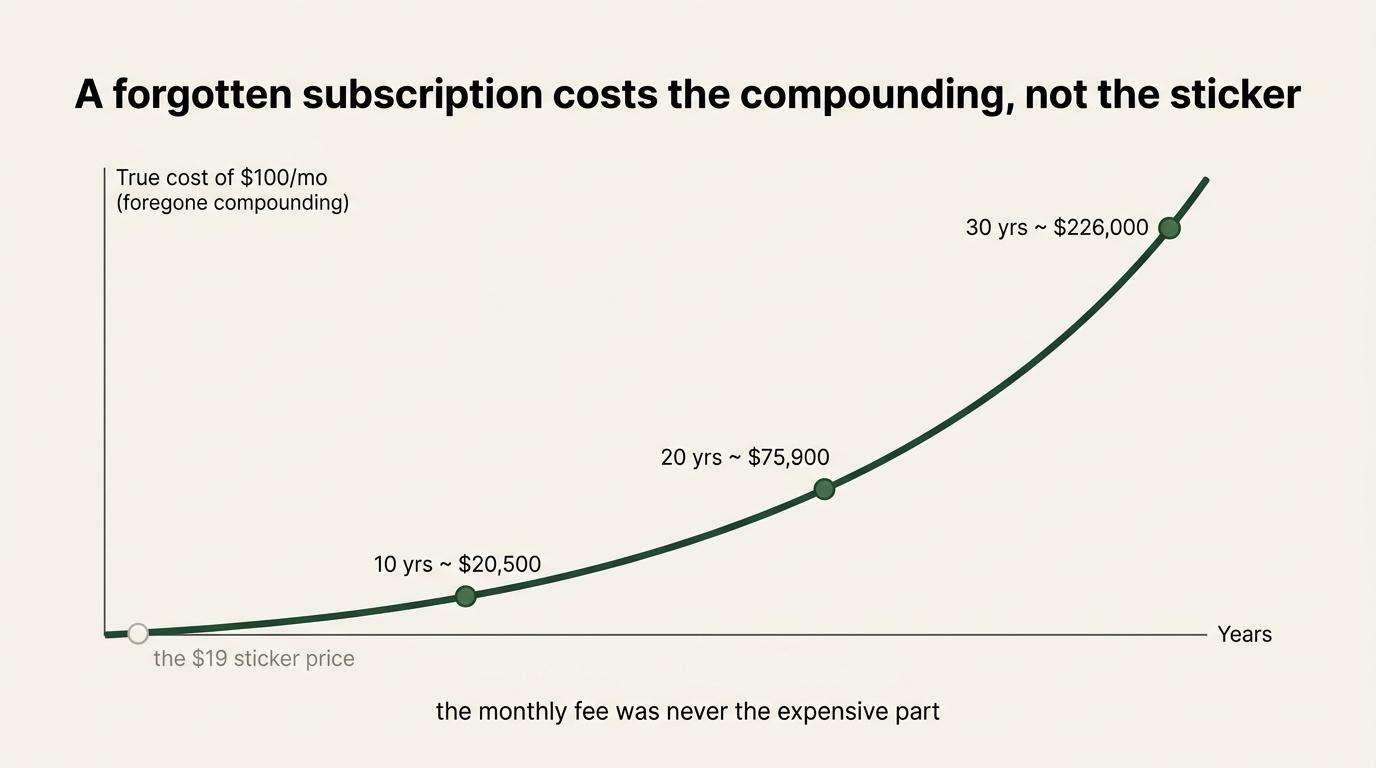
A hundred-dollar monthly charge nobody uses costs a hundred dollars plus everything that hundred dollars could have turned into, and the second number is the one that changes how you look at the list.
Running a hypothetical ten percent annual return, one unnecessary hundred-dollar expense today would be worth around $1,745 in thirty years if it had been invested instead.
A recurring hundred a month, invested rather than spent, runs roughly $20,500 over ten years, $75,900 over twenty, and $226,000 over thirty.
Those are simplified illustrations sitting before taxes and fees and inflation, assuming monthly contributions compounding monthly, and ten percent is not guaranteed by anybody. Some years are negative.
Long-run US equity averages sit in that neighborhood which is why the figure gets used for illustration, and your actual result will be lumpier than a table can show.
What I use it for is the reframe rather than the investment advice. The forgotten $39 video tool stops being a $39 problem and becomes closer to eight thousand dollars of foregone compounding over a decade, before counting the overhead of a tool you cannot remember the purpose of.
That is what makes an hour of teardown worth doing instead of feeling like penny-pinching.
Cutting is only half of it
Worth being straight about, because cost-cutting content tends to imply frugality is the whole answer and it is not.
You should eliminate waste and protect capital, and you should also build the ability to make substantially more money, and those two arguments are not in tension.
There is a floor on how much you can cut and it puts a low ceiling on outcomes. Income without control disappears just as reliably, and I have watched people triple revenue and finish the year with nothing because every increase got absorbed instantly by lifestyle and tooling.
What I am actually after is margin. Enough gap between what comes in and what goes out that I can invest, build runway, absorb risk, and make decisions from strength.
Decisions made from need are worse almost every time. You take the wrong client, accept the bad term, stay in the wrong project because you cannot afford the gap, and each one costs more than the thing you were trying to save.
For anybody paid as a contractor or a 1099 worker this matters more than it does for an employee, because no employer is quietly assembling the safety net on your behalf. Taxes, insurance, savings, investing, and the months that come in light all have to be planned deliberately and in advance by you.
Why a small task gets heavy
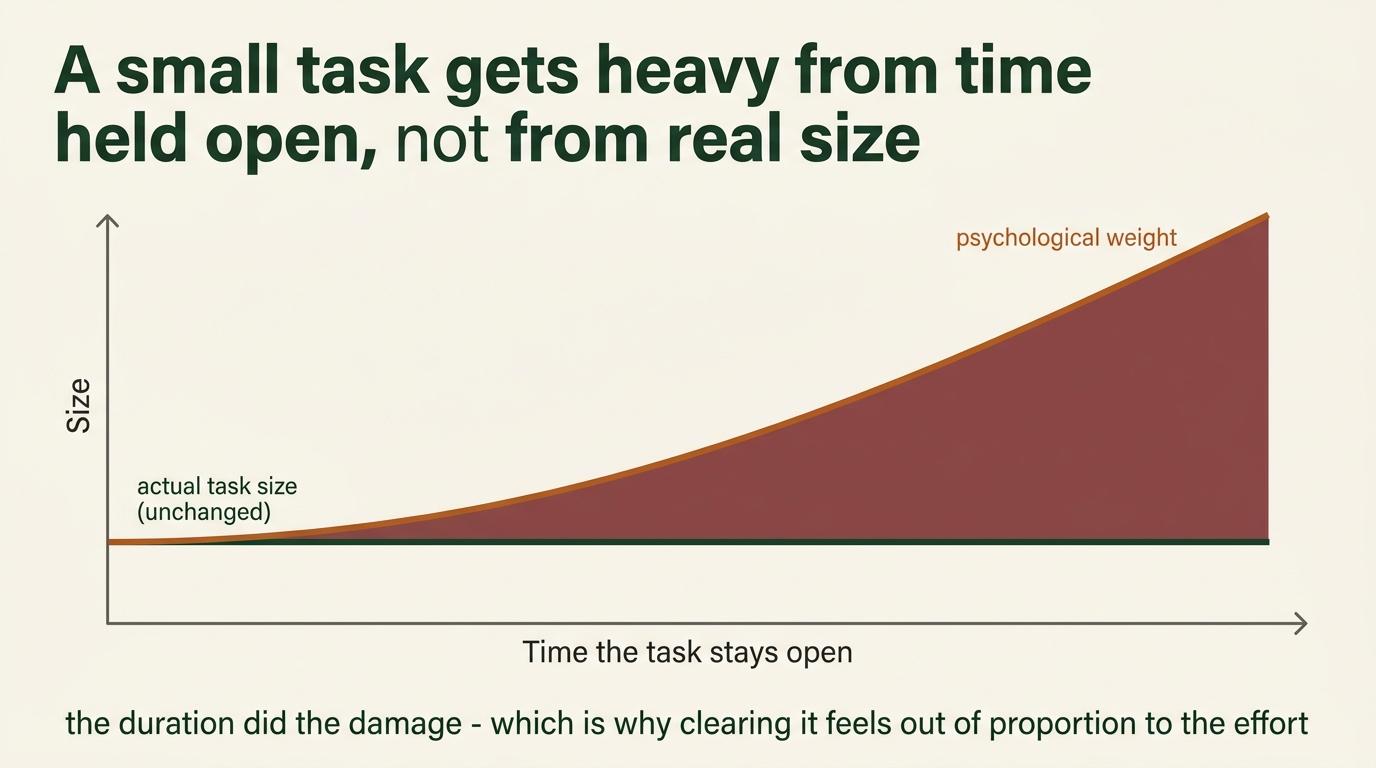
There is an idea in Mark Hoverson's The Million Dollar Day about a seventy-thousand-pound strawberry, and the paraphrase explains the mechanism better than anything else I have found.
A strawberry weighs almost nothing, and holding one in your palm for a few seconds barely registers. Hold the same strawberry at arm's length for several minutes and it starts to hurt, and hold it for an hour and it becomes unbearable.
The strawberry never got heavier. The duration did all of the damage.
Procrastinated tasks behave the same way, where the work stays exactly the same size while the psychological weight climbs every day it stays open. Which is why the relief from a clearance is so wildly out of proportion to the effort involved.
You are putting down eight months of holding rather than doing eight months of work.
And most of the value comes from building the list rather than clearing it. Every quarter, when I write everything down and then review it, between thirty and sixty percent turns out not to be a problem at all. Another chunk is one item pretending to be eight.
Ten to twenty percent can be handled by asking somebody. Some goes to an assistant. What is left gets a date.
There is an enormous amount of operational drag in a normal day that nobody notices because it accumulated slowly. For a long stretch I was swimming through mud. No wonder I felt overwhelmed, and no wonder I burned out every week to three weeks.
Then you clear the drag out and think, this is actually pretty straightforward on a day-to-day basis.
Where I have used clearing as avoidance
This exercise is unusually easy to abuse and I have abused it, so I will name it plainly.
Clearing and tidying and reorganizing all feel productive, and none of them are the work. They pay out in small immediate wins, which makes them an effective way of not doing the thing that actually matters, and I have absolutely used a spring-cleaning afternoon as a substitute for a hard decision.
It is a quarterly one-shot rather than a daily structural lift. If you have any tendency toward compulsive checking or ordering or list-building, this can feed it rather than resolve it, because the satisfaction of clearing is real and available on demand.
And the best way to solve a problem is frequently to decide it is not one. That is the primary defense against running this obsessively, and it is also where most of the value came from in the first place.
If you find yourself running a clearance every three weeks, the clearance has become the avoidance.
Layer 3: Establish direction
SOP 3, the Post-Mortem, Mission, Vision and Values. Subtracts competing directions.
The outcome is removing strategic ambiguity, which is a different thing from having a plan.
Why focus got more valuable once AI made output cheap
This is the argument I would most want you to take out of this document and it has nothing to do with app blockers.
AI made it possible to produce more assets, applications, automations, documents, and campaigns than at any point in history, and I use it constantly, and the cost is that I can now produce enormous amounts of work that should never have existed.
I did exactly that. Most of 2025 and the first quarter of 2026 went into building AI applications nobody meaningfully used, and in several cases mass-market software had solved the same problem years earlier and solved it better.
The pattern shows up everywhere once you look for it. Tools duplicating things that already exist, content with no strategic function, automations layered onto broken processes, and code written because it was possible rather than because the business needed the result.
So in a period where almost anybody can do almost anything, the advantage sits with whoever can identify the one thing that matters and stay on it. Which makes focus a strategic position rather than a productivity habit.
And it means focus does not automatically produce progress. You can become extremely focused on work that does not matter, and that is worse than being distracted, because it manufactures the feeling of progress while a distracted person at least knows they had a bad day.
The most valuable focus is focus pointed at the actual constraint. Everything in Parts 1 through 4 assumes your first constraint is that the environment and the operating process are not making sustained attention easy yet. Aiming it correctly is the harder problem, and it is what the post-mortem is for.
Why the decision mattered more than the effort
For a founder or a salesperson or a CSM or any human being, the quality of the decision often matters more than the raw effort that follows it, because one effective decision can change an entire life.
I learned that the expensive way, and the six-month build is the clearest instance. I was working hard and operating reactively, without enough reflection or willingness to argue against my own ideas, and I never properly evaluated what those projects were costing.
I looked at the possible gain and never at what the decision was taking away from me.
That happens most when somebody is stuck in a hopeless loop, because then anything creating hope becomes attractive and the ways the new idea might deepen the original problem stop being visible. The project stops getting judged on its merits and starts getting judged on how much relief it provides, which is a completely different test and a much easier one to pass.
The asymmetry
Positive decisions usually take time to show up. You can commit seriously to content this quarter and the visible payoff unfolds over the following year.
Negative decisions can land immediately. You can decide to drive drunk tonight and permanently change your life before morning.
Improvement compounds quietly and destruction can happen all at once, and that asymmetry is the entire argument for spending real time on a decision before applying force to it.
What to actually do about it
The answer is improving the quality of the decision rather than waiting for a perfect one, because a perfect decision may be unavailable when you never have complete information.
With enough reflection and open-ended analysis and conversation and argument against your own assumptions, you can usually move from a poor decision into at least a top-twenty-percent decision, and that difference can change the trajectory of a year.
So build structured opposition to your own thinking. A business partner who will argue with you does the job, an AI instructed to challenge you does the job, and a written note listing what already exists that partly solves the problem is the cheapest version of all three.
None of that eliminates uncertainty. It raises the probability that the direction is worth applying force to, which is all any of it can do.
What I actually do with fear
Fear is the number one thing that has stopped me from achieving anything in this life, and I do not think that is specific to me, I think it is most of the game.
The only reliable way through it I have found is playing the worst case all the way out and getting it clear on paper, because fear lives almost entirely in the part of the scenario you have refused to look at.
Worst case, middle case, best case, and with money it gets concrete fast. You cannot pay rent - fine, you did not pay rent, so what happens now?
Could it go on a card, and if it goes on a card how much limit do you actually have and how many months does that cover, and when is the next payment landing?
Once the numbers are on paper it becomes very hard to be afraid. You will still feel stressed, and stressed is a completely different experience from afraid, because stressed is something you can work through.
I think that is most of what people are actually buying when they buy coaching. You get confirmation that somebody already did the thing you are uncertain about, and the confirmation removes the fear, so what got paid for was the absence of fear rather than the information itself.
It is also what I think "it gets worse before it gets better" really describes. Somebody is afraid to do the one thing that would change their outcome, because if they do it and it fails then they are genuinely out of options, so they avoid it, everything around them deteriorates, and eventually they get forced into that exact action with nothing left to lose and it works.
That is real and I have watched it happen more than once. I just do not think it has to go that way if you are willing to conquer the fear up front instead, which is harder and more uncertain and more torturous in the moment, and is exactly why I left it until there was no choice left.
Where that leaves fear in the system
Some fear is useful, because knowing there are real consequences creates urgency and prevents complacency, and pretending otherwise is its own kind of dishonesty.
What does not work is living inside it as a permanent strategy. My reaction eventually becomes am I supposed to feel like this forever, and that is not an existence I am willing to maintain.
And there is a structural problem with it beyond the unpleasantness. As soon as I create some success my mind starts finding reasons to stop being afraid and return to emotional homeostasis, so fear might move me temporarily and it cannot hold a direction. It stops working at exactly the moment I start succeeding, which is the moment direction matters most.
One thing to recognize: a lot of marketing is built on doing the opposite to you deliberately, and anybody pushing you into a life-and-death state of mind is usually trying to get you to impulse-buy. Notice it when it is pointed at you, including when the person pointing it is you.
What we found when we finally sat down
My business partner and I had both independently concluded we were running in circles. Then one of our larger clients downsized their recurring payment structure.
And we happened to be in the same room. Eighteen months of working asynchronously had never produced that conversation, and one week of proximity did, which turned out to be a finding rather than a detail.
Five sessions across three weeks, examining the previous eighteen months, both of us answering separately before comparing.
The thing that came out of it could not have been found by either of us alone.
I had assumed I knew more about business than I did, and I will call that arrogance because it was. He had become passive in areas where he held relevant information, because he read my certainty as evidence that I knew something he did not.
That is one closed loop rather than two mistakes. Confidence without a basis, read as data, going unchallenged, which confirmed it and produced more of it and made challenging it harder next time.
It explains the largest decision we got wrong exactly. He knew the right move and deferred because I was certain, and the deference was entirely reasonable given what he could see from outside.
Neither of us holds more than half of that. I cannot see that my certainty was being read as evidence, and he cannot see that it had nothing underneath it.
Which is why the post-mortem forces both people to answer separately before comparing, and why the whole thing is better run in a room than over a call.
The rest of what it produced: roughly $180,000 in revenue across the period at about 30% margins with headcount peaking around twenty people, which works out to about $9,000 of annual revenue per head and explains the margin without further analysis. A six-month build solvable with a user invite.
Three hires made against instinct that was correct every time. And a total economic loss somewhere between $600,000 and $700,000 once opportunity cost is counted.
What it produced on the other side was clarity and focus at a level we did not have before, because now we know exactly where we went wrong and what has to change.
And the offer this business sells came directly out of it. Neither of us could find the binding constraint early, because you cannot, the same way a novice lifter cannot diagnose their own limiting factor without time under load.
What we sell is saving somebody that specific two years, and we bought the capability with our own money.
Layer 4: Measure reality
SOP 4, Radical Time Tracking. Subtracts illusions about where time goes.
Measurement exists to produce decisions, not dashboards. Everything in this layer is judged by whether it changed what somebody did next.
How the practice actually develops
It is hard at first and it gets easier, and that progression is the thing worth knowing before you start.
The first attempts are clumsy. Forgotten timers, entries remembered an hour late, labels you have to correct. Everybody's week one looks like that.
What improves it is not discipline. It is that the practice keeps surfacing things you did not know, and those things change what you do. You see a fragmented morning and restructure it.
You see a category eating six hours and delegate it. The tracking gets easier because the days get simpler, and the days get simpler because the tracking told you what to remove.
I am considerably more consistent now than when I started, and I still have gaps and days I do not run it at all. That is the shape of it rather than a failure of it.
What the decisions actually are
The output is six outcomes, in a fixed order: not a problem, eliminate, reduce, simplify, delegate or automate, keep.
The order is most of the value. This mirrors Musk's five-step design process, where deleting comes before simplifying and automating comes last. His line for it is that the most common error of a smart engineer is optimising something that should not exist, and his own example is automating a battery-mat process at Tesla before asking what the mat was for. It had been added to reduce sound and was no longer needed.
Most people run a time study and jump straight to delegation, which produces a well-run version of work that should have been deleted.
The evidence, stated honestly
Twelve of forty-six days tracked, and twenty-eight percent of what I did track carried no label.
That is proof of progression rather than mastery, and the distinction matters because the alternative framing would be dishonest. I did not solve time tracking and then write about it. I ran it badly, measured how badly, and improved.
Tracking is genuinely difficult at first and it improves through continued use. Not through discipline. Through the practice surfacing things that change what you do, which simplifies the days, which makes the tracking easier.
Two different things run here. An initial three-to-seven-day diagnostic produces the decisions. Ongoing tracking produces compounding awareness, and that is where the value actually accumulates.
Why one interruption is a hundred interruptions
The mind minimises interruptions instantly and convincingly, because protecting the ego is cheaper than admitting the day fragmented.
So the question is what this costs if it happens one hundred times, which is roughly a year for anything happening twice a week. Five minutes becomes eight hours. A daily fifteen-minute interruption becomes a working month.
That is why strong operators look unreasonable about small standards. They are not defending against the instance. They did this arithmetic once and never forgot it.
Maker work and manager work
Two different ways work produces value, and they need different calendar shapes.
Manager work produces value through interaction. Approvals, decisions, one-on-ones, calls. The productive unit is fifteen to sixty minutes, and moving between things is the work.
Maker work produces value through creating something that did not exist. The productive unit is frequently three hours or half a day.
The row that carries it: for a manager, empty calendar space is unused capacity. For a maker, the empty space is the capacity.
And the shadow cost of a meeting is not its duration. There is anticipation before it, preparation, the loss of depth, the switch, and the recovery afterward. A four-hour maker block with one thirty-minute meeting in the middle does not produce three and a half hours of maker work. It produces two fragments of shallow work.
Two layers of evidence
| Toggl | Macro evidence. It records active human attention rather than unattended AI processing, including work away from a screen |
|---|---|
| Rize | Optional micro evidence. What was observed happening on the machine inside that |
| Rize | Optional micro evidence. What was observed happening on the machine inside that |
|---|
Neither is the other and both are true. The macro layer records intention. The micro layer records behaviour, and it can only see a computer.
Later, a recurring AI job reads both and puts the picture in Command OS alongside everything else. That is a payoff rather than a task, and none of the connection work belongs in this module.
The loop between Layer 1 and Layer 4
This is the part that makes the five layers a system rather than five practices.
- The Focus Stack creates an environment hypothesis
- Radical Time Tracking measures what actually happens inside it
- You redesign the environment based on the evidence
- Continued tracking verifies whether the redesign worked
Project Windows and AI wait-state interleaving are the worked example, and the pairing I run is a demanding exploratory project in Apple Voice Memos alongside a lighter refinement project in Wispr Flow.
The imported doctrine says context switching is the enemy, full stop. Measurement showed me a bounded exception. When a complete unit of work has been submitted to an AI and the result is genuinely pending, moving to a paired project recovers time that would otherwise have been idle, and the data said the re-entry cost was lower than the time recovered.
The point is not that deep-work principles are useless. They are mostly right and they are the default in this document.
The point is that measurement can reveal an exception that produces more useful output for a particular operator, and that the data should refine the environment rather than defend the doctrine. Somebody else's numbers might say the opposite, and that answer would be equally valid because it came from the same place.
The story in my head was always kinder than the truth
I knew what I felt busy doing, I knew which tasks were screaming at me, and I knew what I wished I had time for. What I did not have was a clean record of where the hours actually went, which meant every decision I made about my time ran on a story instead of evidence.
The cleanest way I have found to explain it is food tracking, because almost nobody knows what they are actually eating until they log it. The story in your head is always kinder than the truth, and it stays kinder until the day you write it down without softening anything.
Once somebody tracks a full week honestly, the gap between the story and the reality becomes the whole point.
You cannot change a diet you never measured and you cannot change a calendar you never looked at.
That gap is where the leverage sits, because I could not delegate work I had never examined, protect time I had never named, or fix a bottleneck I had misdiagnosed.
And feeling productive and being effective turn out to be two different things that happen to share the same sensation, which is the part that cost me the most.
This is a diagnostic rather than a discipline. Think about how a good mechanic works versus how most business owners work. The mechanic runs a diagnostic scan first, because the noise the car is making and the part that is actually failing are usually two different things.
A doctor does the same thing when they refuse to treat the first symptom without asking what it points at. I did the opposite for years. I fixed the thing making noise, and the thing making noise is almost never the thing that is broken.
Your calendar is your current reality
Worth sitting with before tracking anything.
My calendar reflected my current skills and beliefs and self-image rather than the ones I wanted, and that was uncomfortable to notice because the calendar is not editorializing. It is a record of what I actually agreed to.
Maxwell Maltz built a whole book on this in Psycho-Cybernetics, and the useful part is the mechanism rather than anything mystical. How you see yourself shapes what you do, and what you repeatedly do gets written into your schedule.
Put a calendar from three years ago next to one from today and you can see the change in who somebody was without either of you saying a word about it.
It is also why tracking comes after the post-mortem rather than before it. Time data with no stated direction is a report nobody can act on, because there is nothing to compare it against. Once a direction exists, the same data turns into a verdict.
The constraint above the constraint
For early-stage founders and small teams, time usually sits above every other constraint, and this is where the Theory of Constraints gets applied too narrowly.
The theory is sound. Find the biggest bottleneck and improve that first. The trouble is that it assumes you can see the constraint, and I could only see symptoms, so I kept looking for the constraint inside the business while ignoring the one sitting above it.
A founder says marketing is the bottleneck and that might be true, and if they have been meaning to build the content system for eighteen months without creating the space to do it, then the immediate constraint is time rather than marketing.
Another says lead flow while every week gets eaten by admin and delivery cleanup and questions and client fires. A third insists they need better systems with no idea which recurring work consumes the most hours, which means they are guessing at the system instead of diagnosing it. I have been all three.
Today work and tomorrow work
The sharpest version of the trap.
Today work keeps the business alive today. Tomorrow work makes it stronger and easier and more valuable tomorrow.
Both matter, and the business generates a constant stream of urgent today work, so it is easy to spend every day there and never reach the compounding work that would change the position.
Spend every day keeping the business alive today and the thing that keeps it alive tomorrow never gets built.
Why this settles the overwhelm
Tracking calms people down for a specific reason, which is that the brain handles difficulty far better than it handles complexity.
Difficulty is clean and complexity is fog.
The gym is the easy example, because the workout is hard and the harder part is usually everything around it. What to wear, when to leave, which workout, how it fits into the rest of the day. Once you are standing there with a plan the task is simple, which is lift the weight and finish the set.
Business overwhelm works the same way, where the hard work is rarely the real problem and the problem is the unresolved complexity wrapped around it. What to do first, what matters most, what you are avoiding, and what is actually eating the time.
Tracking externalizes that complexity. It moves the fog out of your head and into something you can see, and a visible system is something you can reason about instead of something you carry.
It does not make the work easy. It makes it clear, and clear difficulty is far easier to face than invisible overwhelm.
Two specific things it does. It creates evidence that something is moving, which matters because a lot of overwhelm is about the absence of visible progress rather than workload. And it reveals the day where you touched five things and finished none of them, which is the pattern memory never catches and the record always does.
And the failure mode attached to it
There is a difference between visibility and obsession.
Visibility means tracking long enough to see the pattern, making decisions from it, and changing what happens next. Obsession means the tracking became the activity, and I have been on the wrong side of that line.
Tracking behavior that is not directly correlated to a change in behavior is meaningless. Data for data's sake has no value, and it is actually worse than that, because it clutters the difference between what is important and what is not.
If two months of tracking has produced no delegation decision and no elimination decision, the tracking is not doing its job no matter how complete it is.
Layer 5: Install the operating cadence
SOP 5, the Habit System. Subtracts the recurring daily negotiation.
This layer is what turns the first four from one-time discoveries into something that holds.
Why I put habits at the end
Habit tracking arrives last for a reason, and it is the reason most habit systems fail.
Before there is focus and a cleared environment and a direction and visibility into real behavior, you do not know which behaviors deserve to be recurring. So systems get built around activities that do not matter, or around work that should have gone to somebody else.
I did the second version. I built two systems around work that should never have been mine, and both ran beautifully for a couple of months while making my situation worse.
The four things before it are the filter. Focus tells you what you can protect, the teardown clears the noise, the post-mortem gives you a direction, and tracking tells you which work should be eliminated or automated or documented or delegated.
Whatever survives that is what belongs in a habit system, and a habit built around the wrong task is a well-engineered cage.
The filter, stated as a question: does this behavior deliberately support something you have decided matters?
That is broader than a business outcome, and it needs to be. A behavior qualifies if it preserves the operating floor the first four modules produced, strengthens you biologically, strengthens you psychologically, improves health or energy or resilience or recovery, supports a personal outcome you chose, supports a role or business outcome, or stops an important routine collapsing in a difficult month.
What it is not is whether the behavior looks like a good habit. Almost everything looks like a good habit in isolation. The question is whether you decided it matters and can say why.
If you cannot, it is a preference. Preferences are fine, and they do not need a tracked slot, and every slot spent on one is a slot not spent on something load-bearing.
The dashboard I built instead of going to the gym
This needs saying before anybody opens the habit SOP, because it is the most likely way to waste a week and I lost more than a week to it.
A perfect habit tracker is not going to change your life on its own, because most of the outcome still comes from doing the behavior when you do not feel like it, and no software has ever changed that part.
I used to build super complex trackers and track absolutely everything about myself. I would get fascinated building these habit systems, genuinely believing I was about to construct the perfect productivity system that would finally make work easy.
Work is never going to be easy. It is always going to suck to some degree, and the idea is that it sucks a lot less when you are not nuking your dopamine and carrying a thousand different things in your head at once, because then you can actually enter into it and reach something like a state of peace while doing hard work.
That is what the system is for. It is not going to do the work.
So the tool removes friction and clarifies expectations and makes patterns visible, and it cannot perform the habit. Which means three weeks spent building a beautiful dashboard instead of going to the gym or writing the page or making the call is avoidance wearing the most convincing costume available. It has the entire texture of work and none of the cost.
Given a choice between a rough system running today and a perfect system running next month, run the rough one today.
The timeline nobody tells you honestly
I kept hearing twenty-one days, so I went and looked.
The best study I found tracked 96 people over twelve weeks and landed on a median around 66 days before a new daily behavior went automatic, except the range ran from 18 days to over two hundred and about half the group had not gotten there at all by the time it ended. A larger review a few years later came out in the same neighborhood with even wider spread.
The most useful finding in the whole literature is the one nobody repeats, which is that missing a single day did not break the curve.
So I treat four to twelve weeks as a practical reinforcement window based on that and on what I have watched happen with myself and the people I have handed this to, and I would not defend it as more than that.
The twenty-one days figure, incidentally, comes from a 1960 observation in Psycho-Cybernetics about plastic surgery patients adjusting to a new face rather than from any habit research, which is a strange fate for a genuinely good book.
What I got wrong about where habits should live
I need to walk this one back properly, because the previous version of this document argued the opposite at length and the reasoning was not stupid. It was one layer off, and it took building the whole thing to find out where.
What I believed
My habits lived in ClickUp because my business tasks and projects were already there, and centralization was the whole advantage. I did not want a personal habit island disconnected from the rest of the operating system.
I had gone through Habitica, Notion dashboards, Google Sheets, and a fair amount of other stuff I have forgotten. Every one of them fell away eventually, and I diagnosed the cause as the same thing every time: none of them lived where I also do my work, so using them meant switching software, and the context switch killed the habit of using the habit tracker.
Which is a slightly absurd sentence and it is exactly what happened.
What I built on that belief
A month, day, routine, section and checklist architecture inside ClickUp. Rolling deployments generating future days.
Section completion tracking. A webhook writing to a database so history was permanent and could not be edited away.
A dashboard showing streaks, consistency by routine, estimate against actual. A nightly summariser turning comments into a weekly narrative. Scheduled generation running unattended.
A lot of that was technically good and most of the principles underneath it survive intact.
The mechanics do not. The recurrence engine, the external database, the dashboard, the generation and the rollover machinery are superseded rather than an advanced version a keen reader might still implement. All of it existed to reproduce capability a dedicated product has natively, and rebuilding any of it would be repeating the exact mistake this section describes.
What actually happened
The scheduled deployment never became reliably hands-off, so I was still manually firing it. That was the visible failure and it is the smaller one.
The real problem is that I had built a recurrence engine around a tool that is not a habit tracker. ClickUp does not do recurring behavior natively in the shape a habit system needs, so I constructed the missing capability myself: generation, rollover, history, streaks, visualization. Every one of those is a solved problem inside a dedicated habit product that costs a few dollars a month.
I spent months reproducing features that already existed, because the platform I had chosen for a different reason could not do the thing I needed.
And then I stopped using it. Two completions in the system, both in the same week in July, nothing after. Not because I stopped believing in habits. Because I stopped opening the interface.
Why I stopped opening it
Here is the part I did not see coming, and it is the actual lesson.
ClickUp is my work environment. I would open it to tick a personal habit, and there would be client tasks, overdue work, notifications, business fires, and fifty different opportunities to start working instead.
The system designed to help me maintain my state was routing me through the environment most likely to destroy it.
Which contradicts a principle this document has argued since Part 3: performance is downstream of state, and state maintenance should not have to compete with client fires. I applied that to physical environment and notification design and browser profiles, and I did not apply it to the one place it mattered most.
What I had confused
Centralization and integration are not the same thing.
I wanted my systems to talk to each other, and I assumed that meant they had to live in the same interface. They do not. Two systems can communicate perfectly well through an API while living in completely separate places, and the separation is frequently the point rather than a cost.
We had already separated the personal layer into its own ClickUp space for exactly this reason. What I have done now is take that principle one layer further and separate the interface as well.
The architecture that replaced it
Habitify is the execution surface, and it is one of five layers rather than the whole answer. Getting these confused is what produced the previous system.
| Approved configuration | The durable behavioral definition. Areas, behaviors, block mapping, order, timing, recurrence, reminders, descriptions, icons |
|---|---|
| Habitify | Live execution. Completion and history |
| Habitify calendar sync | A downstream visual schedule |
| Google Calendar busy guardrails | Booking protection. Not habits, and not a second definition |
| AI jobs + Command OS, later | Reads and displays. Nothing else |
| AI jobs + Command OS, later | Reads and displays. Nothing else |
|---|
The durable-config principle is the part I would have skipped a year ago. The definition and the execution surface are deliberately separate. Account state carries whatever was true at the last partial edit, so rebuilding from it recreates things you deliberately removed. The file is authoritative, the app is what runs.
Most of what I built becomes unnecessary. No daily generation. No custom rollover. No separate database just to have permanent history. No dashboard maintained by me.
On Habitify specifically: it handles recurrence, reminders, completion, progress and history natively, and it has an API on the Pro plan. It has Areas for grouping.
It also has Actions, which are checklist items inside a habit, and those cannot be written through the API - so deployed behaviors live inside the habit description as instructions, and per-behavior ticking is something you add by hand if you want it.
And the thing I actually wanted from it is better. Open it, see what needs to happen, do it, mark it, close it. No client work in peripheral vision.
One habit per behavior, or grouped blocks
A conditional choice rather than a doctrine, and it comes down to what your calendar does.
Habitify's calendar sync renders every habit as a roughly thirty-minute event with no duration control and no per-habit exclude. So if your behaviors are few, or spaced far enough apart, one habit per behavior is simpler and correct. If you have many small actions close together, they collide into a calendar that is useless for the thing a calendar is for, and grouping them into larger blocks fixes it.
My implementation, as evidence rather than a target: four Areas, twenty-three atomic behaviors, folded into fifteen thirty-minute blocks. Ordered codes in the block names so the routine sorts in sequence.
Start-time reminders. Sun for morning blocks, moon for evening.
Activities longer than one slot split across consecutive blocks and marked as intentional splits. Three recurring busy guardrails protecting the morning, Sunday and evening windows.
That constraint produced fifteen for me. It does not produce fifteen for anybody else, and SOP 5 has Claude Code derive the structure from the actual routine rather than from a template.
What has been verified, and what has not
Verified live: authentication, the initial creation path used in the original deployment, reminders, recurrence, and calendar rendering. The structure deploys and behaves as described.
Not yet independently revalidated: the complete current partial-update field matrix documented in the V2 specification.
Not verified: long-term adherence. The current blocks were deployed recently and do not have months of completion history behind them. The system before it had almost none.
So this is proof of progression and working infrastructure, not proof that the behavioral system has held over a long period. The Day 30, 60 and 90 checkpoints are where that gets tested honestly.
The lesson, stated so it transfers
Do not automate around a platform's missing core capability when a focused product already solves the problem.
That is the most expensive thing I have learned building any of this, and it is a strange lesson to have learned inside a document whose entire argument is subtraction. I wrote Part 2 about removing rather than adding and then spent months adding infrastructure to compensate for a wrong tool choice.
The old system is not wasted work. It is evidence, it bought better doctrine, and every technical principle it taught survives the implementation dying.
The criteria, which have not changed
The standard has nothing to do with which tool you pick.
The habits are objectively clear, so somebody else could read one and know what it means. The recurrence is clear, so you know when it is due without deciding. Completion takes under ten seconds to record. Progress can be reviewed, so you see a pattern rather than only today.
Two I would add now, both learned the hard way.
The interface should not contain your work. If opening the habit tracker exposes you to client fires, you will stop opening it, and the reason will look like discipline rather than design.
The tool should already do the thing. If you find yourself building the recurrence, the history, or the rollover, you have chosen the wrong tool and the build is going to cost more than the switch would have.
If you already have a habit system that works, do not rebuild it. Take the structural ideas and apply whatever improves what you have.
Not all data is good data
Most trackers fail one of two ways. They show you nothing useful, or they dump maximum data to look impressive and bury you, so you stop opening it.
The rule: only track inputs that raise the probability you do the recurring action. That is the literal definition of support, and a number failing that test does not belong on the page.
Consistency is not rigidity
The point of an operating system is to execute the current model reliably. That is not the same as refusing to reconsider the model.
Scheduled reviews exist so the system can be challenged on a rhythm rather than only when something breaks badly enough to force it.
Execute the current system reliably. Review it deliberately. Change it consciously. Then execute the new system reliably.
Do not confuse a streak with wisdom. A ninety-day run of a habit that stopped mattering on day twelve is not discipline, and the streak is exactly what makes it hard to see. The habit engine above ran for weeks generating days into a void, and the generation never missed once. The automation was perfectly consistent. The system was obsolete.
The review is what stops consistency from becoming the thing preventing improvement.
PART III: RECOVERY IS PART OF THE SYSTEM
The first two parts make somebody considerably more capable of consistent execution. Which raises the next question immediately.
How hard should that system be run, and for how long?
Better systems let you apply more force. They do not remove the need to recover from applying it.
Four ideas, and everything in this part supports one of them. Capacity has limits. Recovery is structural. Watch for degradation. Recover deliberately.
1. Capacity has a ceiling
Increased capacity is not infinite capacity.
Everything above builds a high-constraint operating mode, and nothing in it tells you what happens if you run that mode flat out for six months.
The maximum rate of demanding work you can sustain is set by recovery capacity rather than willingness, and protecting attention without managing load produces a shorter runway rather than a longer one.
The clearest version of this in my own life came from powerlifting in high school.
My back was already damaged from wrestling because I had spent so much time bent over, and then I started running a Bulgarian-style squat-every-day program, so my total went up while my back got progressively worse.
For months I treated the pain as irrelevant, and my internal frame was that my legs did not care that my back hurt so I should keep training them anyway.
Over Christmas break I lost access to the school gym and got forced into about two weeks off. When I came back my back did not hurt, for one of the first times I could remember, and I had one of my best leg sessions in months.
Over the following weeks my performance improved and my legs actually grew, after months of forcing work without recovery.
The lesson was that my body was one organism, and constant systemic fatigue was preventing the individual parts from developing. I was not failing to train hard enough, I was failing to let the training land.
The same thing applies to knowledge work, because action matters and some growth happens passively when the mind has room to recover and integrate and connect things. Which is why people get ideas in the shower or on walks.
The idea did not fall out of the heavens. The mind finally had enough unstructured space to connect information it had been processing in the background.
And it scales. A business quarter behaves the same way, because twelve weeks of continuous execution with no reset produces accumulated fatigue and drift from the original objective and a slow decline in decision quality that nobody notices because everybody is busy. A deload is part of the program rather than a break from it.
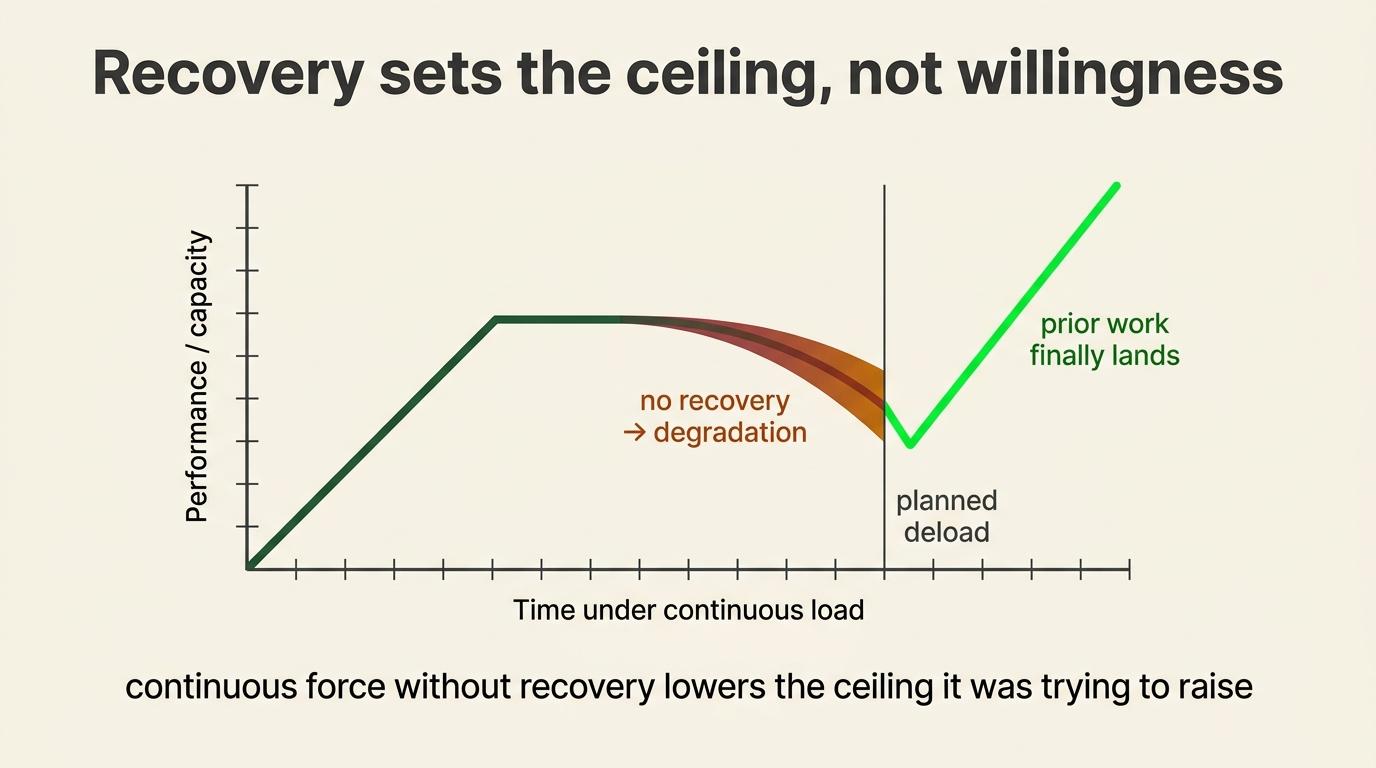
2. A sprint is not an operating model
I have been to the edge of my capacity and I would not recommend it as a strategy, though I am not going to pretend it taught me nothing.
Fourteen months of door-to-door sales got me to a point where I would rather have disappeared than knock another one, and that experience is what pushed me out of door-to-door and into online business, which changed my life.
It was still a miserable and structurally inefficient way to operate. I could not use the bathroom when I wanted, I was always walking in extreme heat or extreme cold, every closed deal reset to zero the next morning, and there was almost no recurring leverage anywhere in it.
What it gave me was the end of any remaining fantasy about living in that state permanently, which is a different thing from the overload having been good for me.
Where I disagree hardest with a lot of discipline content is the repeated-burnout idea, because a brain and a body are not machines that get infinitely stronger every time you overload them, and you can force adaptation in one dimension while degrading the larger system that made continued performance possible.
Somebody working at an unsustainable level believes they are pulling the future forward, and what they may actually be doing is borrowing from the future at a terrible interest rate, which gets paid back through health problems and hormonal disruption and hatred of their own work and damaged relationships and years spent rebuilding what they destroyed.
You think you are saving time, then you pay twice in blood.
The military mentality of pushing regardless is useful during a sprint and irrational as a permanent operating model, because you cannot sprint forever, and at some point refusing to change the system is not discipline, it is stupidity wearing a work ethic costume.
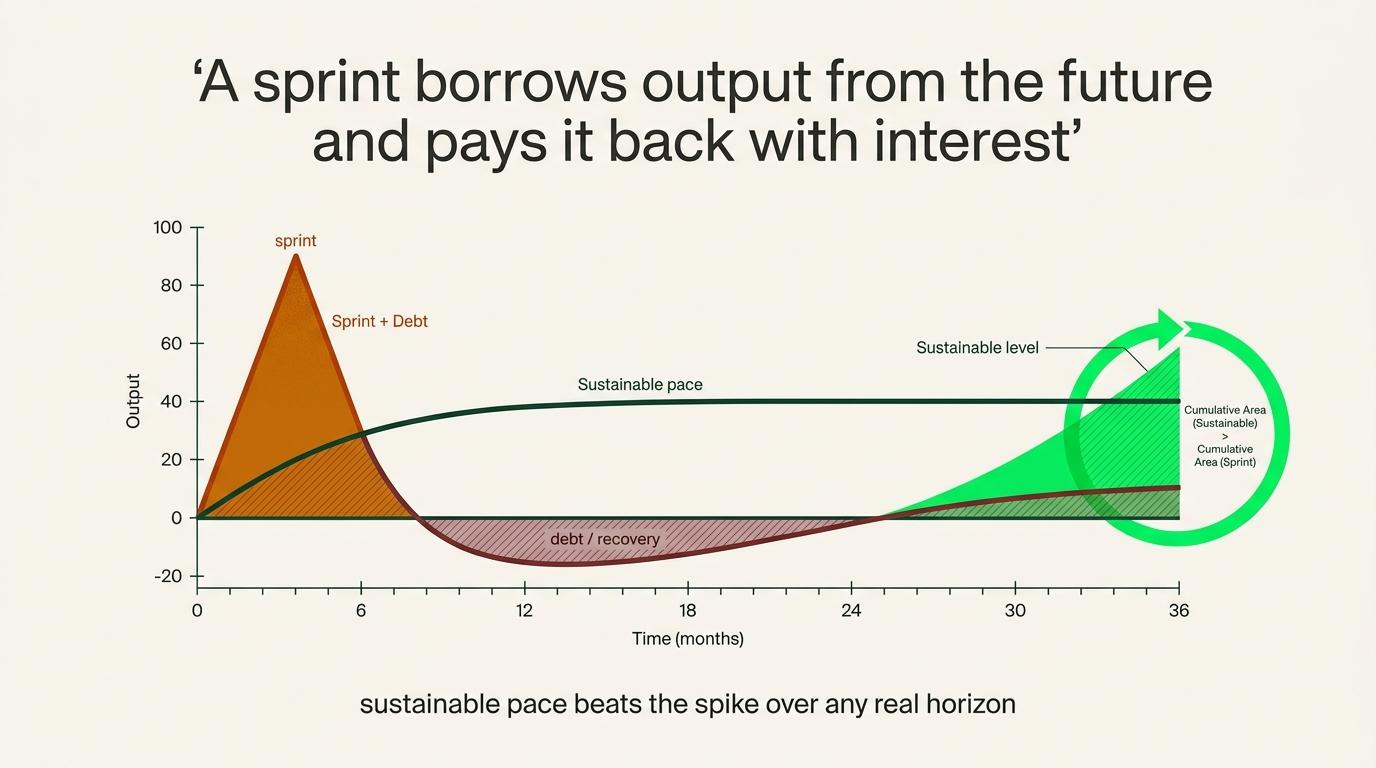
3. The two recovery inputs I kept treating as optional
Everything above is about noticing the ceiling once you are near it. These two are what raise it, and I spent years treating both as things you do after the work is handled.
Sleep
I do not have a sophisticated version of this.
Staying up does not buy you hours. It buys you a longer period during which very little happens, and then it charges you for the next day as well.
I have written things at two in the morning that I deleted at ten. I have sent messages I had to walk back.
I have spent whole afternoons rereading my own paragraphs because none of it was going in.
It is the most expensive mistake I have made repeatedly, and the reason it kept happening is that the cost never arrives at the moment of the decision. At midnight the trade looks like two more hours of work against two fewer hours of sleep. What you are actually trading is two hours of degraded output against most of tomorrow.
No blocker I have ever installed covered for a week of four-hour nights. The Focus Stack cannot make you focus if the underlying machine is not running.
Human connection
I used to think time with friends and family was the dumbest, most beta thing in the world. I looked down on people who prioritised it. I thought it was what you said when you did not want to work.
That was wrong, and it was expensive, and I want to be precise about why rather than just recanting.
It is not abnormal to work in pain. It is abnormal to focus in pain.
Those are different claims and the distinction is the whole thing. You can produce an enormous amount of work while miserable.
I have. What you will probably not do is move in the right direction, or notice that the thing in front of you is not the highest-leverage thing available, or catch the decision three weeks earlier that would have made the last three weeks unnecessary.
Part 5 already argues that direction precedes effort. Misery does not stop the effort. It stops the direction.
And it is genuinely hard to focus when you are miserable or in pain. Not impossible. Hard, in a way that costs more than the hours you think you are saving by not stopping.
And that argument has a second half I only understood after living the other side of it.
I worked almost entirely from home for about two years. I ordered what I needed rather than going out for it. Most weeks I could count the in-person conversations on one hand.
Sales hid it for a long time. I was on the phone with strangers every day, and that felt like enough human contact to count.
Build mode is where it showed up. The calls stopped and nothing replaced them.
What replaced them, eventually, was podcasts. Entrepreneurial interviews, mostly.
And at some point I noticed that finding a new one I liked produced something close to the feeling of meeting somebody I might become friends with. That is a strange thing to notice about yourself and it took me a while to admit what it meant.
It became a dependency rather than a preference. If something interrupted a full day alone, I read the day as wasted. My tolerance for working around other people went down rather than up. And I got stuck inside recursive arguments in my own head with nothing external to break the loop.
Solitary confinement was introduced in the late 1700s as a humane reform. Isolation and a Bible were supposed to produce penitence.
Observers were documenting the failure within decades, and the US Supreme Court recognised it formally in 1890, describing prisoners who came out semi-fatuous or violently insane and often never recovered. Modern clinical work describes a specific syndrome from social and sensory deprivation, appearing in people with no prior mental illness. The UN treats anything past fifteen consecutive days as prohibited.
Working from home is not prison and I am not claiming it is. The reason the research matters is narrower than that: it establishes that meaningful human contact is closer to sleep or food than to a preference, and that removing it produces deterioration on a predictable timeline rather than being a matter of character.
Newton produced calculus during two years avoiding the plague. Thoreau produced Walden. Every contemplative tradition independently arrived at extended withdrawal as the method for depth.
Same physical condition, opposite outcomes, and four things decide which one you get.
| Chosen | You decided to be alone, rather than it being done to you |
|---|---|
| Purposeful | There is a specific thing the time is for |
| Resourced | You have what you need to do that thing |
| Time-bounded | It ends, and you go back |
Remove any of those and generative solitude turns into the destructive kind.
Which is why this oscillates with the business. During a good stretch, long solitary work feels chosen and purposeful, because progress is visible and you picked this. During a long bad stretch, the identical routine starts feeling inescapable, because nothing is moving and it is not obvious you are choosing it anymore.
Same desk. Same hours. Completely different psychological experience, and the variable is the business rather than the discipline.
This applies to your team too, and more sharply for remote people with no client contact. If the work stays hard for months and they cannot see progress, choice, growth, direction or another person, their experience moves the same way yours does. That is worth knowing before you conclude somebody has a motivation problem.
The failure mode is not deep work. It is deep work with no return leg. SOP 1 covers what the return leg looks like in practice.
If you are not in a position to take a day, keep going. That is a real constraint and I am not going to pretend otherwise from a chair.
If there is some cash set aside and you have been running at the edge, take one. Take two. You will come back with something you cannot manufacture at the desk, and the two days will cost less than the fortnight you are about to lose by grinding through.
4. Know when the system is degrading
Do not wait for collapse before changing load. When several of these start running together, recovery is going to happen either way. The only question is whether you choose the timing.
Work quality dropping while the hours stay the same. Emotional regulation going, which shows up as snapping at people who did nothing. Fog that sleep does not clear, sleep breaking, rest that stops restoring anything, and withdrawing from people I normally want to see.
When several of those run together I take real recovery before it becomes involuntary, and if they were severe or persistent I would treat that as a conversation with a doctor rather than another productivity protocol.
5. Rest is judged by what it produces
The test for whether rest is rest: what condition does this activity reliably leave me in?
Scrolling for forty minutes and standing up feeling worse is a different delivery mechanism for the same problem the rest of this document solves. A walk with no phone, a nap, a sauna, real time with people, or an hour where nothing is being asked of me all pass.
Run that test honestly and a meaningful share of what you currently call resting turns out to be avoidance, which is what I found when I ran it on myself.
6. Do not make ambition somebody else's collateral damage
A sustainable system has to account for the people around you, and this is where most founder productivity content goes badly wrong.
Total sacrifice across every area of life is not automatically the ideal outcome.
Some sacrifices are necessary, and others only look necessary because somebody refuses to have a difficult conversation.
That is especially true in family and relationships, because openly explaining what you are trying to build and why it matters and how long the intense period may last and how you want the other person involved makes the whole situation clearer.
They may support you, and if they do then they get to be beside you through the process rather than treated as collateral damage. If they consistently undermine the direction despite honest communication then you have useful information about the relationship, which is also worth having.
What ruins people is disappearing into a dark-focus state without explaining anything, so they stop communicating and become emotionally absent and then read the other person's frustration as proof that nobody supports their ambition. When the more likely explanation is that they communicated badly and built a self-serving story around their own behavior.
If your partner's goal is to maintain a relationship with you, and your behavior communicates that only your goals matter, you cannot be confused when they stop caring about your goals.
A hard conversation is usually a better first step than quietly deciding everybody around you is an obstacle.
FINAL OPERATING GUIDANCE
When to run this again, and when to prescribe it
The five modules are not a one-time onboarding artifact. I rerun pieces of this regularly and I have handed the whole thing to people who needed it.
Rerunning it on yourself
Not because ninety days elapsed. Because the signals show up.
| Signal | Where to start |
|---|---|
| Sustained context switching | The environment layer has decayed. Module 1 |
| Cannot state your central priority in one sentence | Direction has gone quiet. Module 3 |
| Persistent missed commitments | The cadence broke, or it was built around the wrong things. Module 5 |
| Task accumulation with nothing shipping | Usually a capacity problem wearing a productivity costume. Module 4 |
| Time allocation diverging badly from stated objectives | The gap between what you said mattered and what you did. Modules 3 and 4 |
| Constant reactivity | Everything upstream. Start at Module 1 |
| Visibly decayed work environment | Module 1, and usually the cheapest fix on this list |
| Overwhelm driven by unresolved obligations | The Productivity Clearance in Module 2 |
The tell across all of them is the same: your internal operating environment is degrading faster than you are maintaining it.
Get your own working first
Do not roll any of this out to a team before it works for you.
If you cannot maintain your own habits and your own time tracking, do not build a company ritual around habits and time tracking. You will amplify a broken standard, and the team will correctly read that the ritual is theatre.
A rollout does not repair a weak system. It multiplies it.
Prescribing it to somebody on your team
I have done this and it works, and it needs framing carefully or it reads as a punishment.
When somebody becomes extremely scattered, overloaded, reactive, missing commitments, clearly operating inside a broken decision environment, more work is not the intervention. Adding tasks to somebody whose operating environment is the problem produces the same output more slowly.
So the intervention is to stop. Give them several days where the job is: run the Reset. Do the clearance. Fix the environment. Revisit the direction. Track what is actually happening. Rebuild the cadence. Then come back.
Frame it as maintenance rather than remediation. The person is not being sent away to fix themselves. Their operating environment has degraded, that is normal and it happens to everybody, and clearing it is a legitimate use of their week rather than a break from real work.
And do not prescribe it as a substitute for a conversation you are avoiding. If the actual problem is that the role is wrong, or the workload is genuinely impossible, or something is going on in their life, the Reset does not touch any of that and prescribing it instead is worse than doing nothing.
What graduating looks like
Do not define success as three days having passed. Define it by state and output.
The meaningful clearance is done, or under deliberate control. They can state the current central priority or operating objective.
The work environment is cleaned and reset enough to operate in. A real time-tracking study was completed, and decisions came out of it.
The recurring habit cadence is installed. The necessary calendar protection exists. They can explain what changed and why.
Then a stabilization period. They are operationally graduated once they can run the system for a full normal week without somebody else rebuilding or explaining it.
Installation and mastery are different things. Somebody can install all five modules in a week and still need a month before it runs without support. Treating installation as the finish line is how a prescribed Reset produces a person who now has five documents and the same problem.
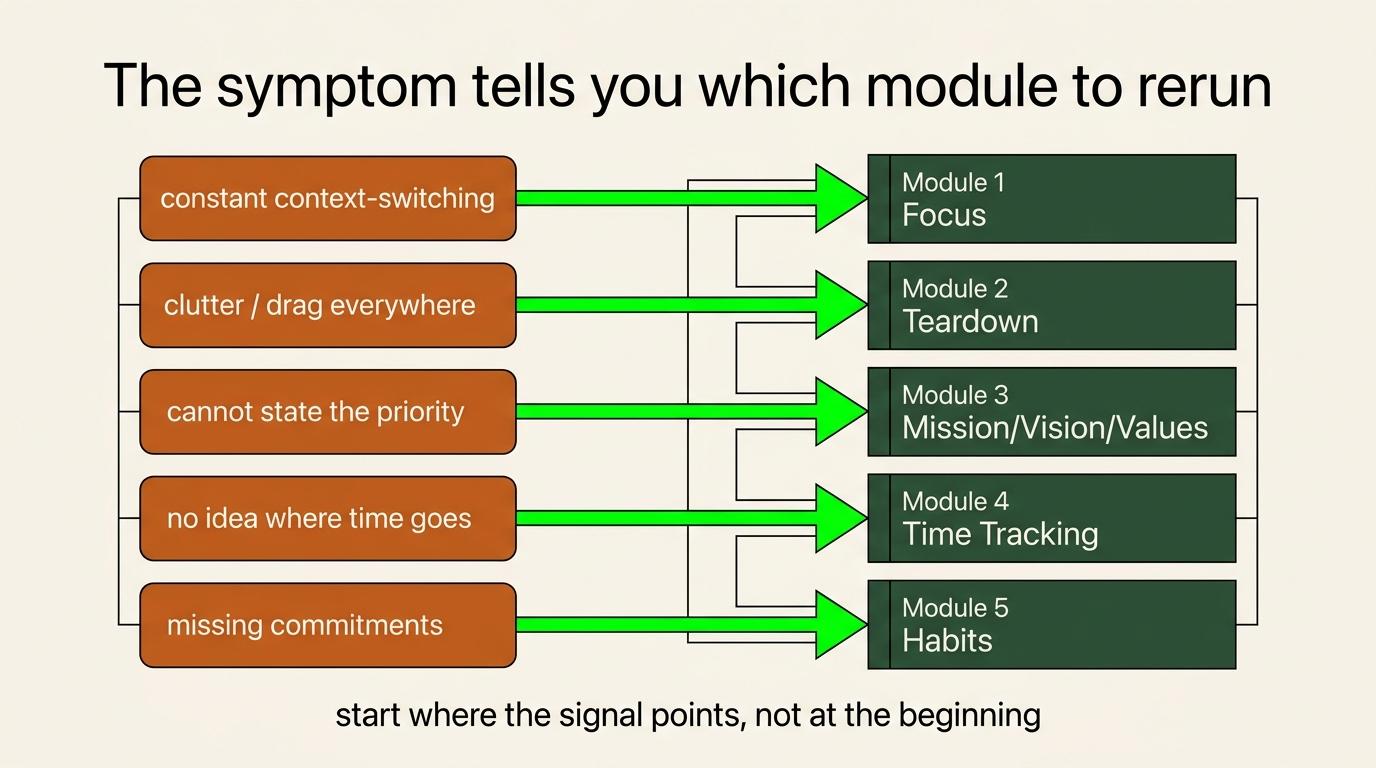
CLOSING: RUN THE SYSTEM
How the five fit together
Five documents, in this order, each producing the input the next one needs.
1. The Focus Stack. Reduces distracting stimulus and protects attention. If you cannot hold attention on something unpleasant for an hour, nothing downstream lands.
2. Tech Teardown and Spring Cleaning. Removes the open loops and unnecessary infrastructure and financial clutter that piled up while attention was elsewhere. Also the one that pays you back in cash.
3. Post-Mortem, Mission, Vision, and Values. Removes strategic ambiguity by examining what actually happened and then choosing a direction. Backward first, then forward.
4. Radical Time Tracking. Removes the false beliefs about where time and energy and attention actually go.
5. The Habit System and Operating Cadence. Removes the recurring daily decision by turning the first four into an operating rhythm.
Which ones you actually have to run
Inside a Funnel Futurist engagement, two of the five are required and three are not.
| Modules 3 and 4 | Required where we are placing an operator on your team. The post-mortem gives that person a direction to work against, and the time study gives them something to take off you. Placing somebody into a business with neither is how a placement fails for reasons that have nothing to do with the person |
|---|---|
| Modules 1, 2 and 5 | Optional. Advised, and optional |
The order still holds if you run all five, and each one still feeds the next. Run only 3 and 4 and you get a direction and a delegation list without having cleared the environment or the clutter first, which works and works less well.
Why I would still do all five. It produces an actual structural reset at the point where a reset is worth the most, before an engagement rather than partway through one. It positions you for everything that follows, because the offer and operations work later assumes you can hold attention and know where your time goes.
And every module produces an output your dashboard reads, so running them is what makes the dashboard show something real rather than a shell.
The optional AI layer
The five modules run standalone and produce five finished documents. Nothing in them requires sharing access with us.
Inside an FF engagement you can optionally connect those outputs to the AI layer: AI SOPs (written instructions for a recurring AI job) that run on a schedule and report into your Command OS (the view that shows the state of the business). That layer turns five documents into a live operating picture instead of five artifacts that go quiet after a month.
That connection happens at the end of Orientation and you decide what gets connected. Each AI job reads only what you connect to it and reports to you. Nothing is connected on your behalf, which means the promise above survives the AI layer intact.
Nothing below requires it. Where a module produces something an AI job will later use, the module says so and carries on.
This document is the canonical source. Later phases reference it rather than reteaching it, because it receives updates at Day 30, 60 and 90, and a second copy anywhere would start diverging inside a month.
Timing, honestly
The core system installs in about six to eight focused hours across all five. Roughly thirty minutes for the Focus Stack, two to three hours for the software teardown including the financial layer, two to three hours for the post-mortem, fifteen to thirty minutes to configure tracking, and an hour for the habit build.
Three things sit outside that. The Productivity Clearance is its own project and runs several hours to a full day. The post-mortem goes as deep as you take it. And tracking needs three to five days of observation rather than setup.
What matters more than the total is the distinction underneath it. The installation is fast and the reinforcement happens over weeks. You can install every system inside a month, and whether the behavior survives long enough to become how you operate is a separate question with a longer and much less predictable answer.
The physical floor
Whenever I am deploying this I am assuming I am also working toward a basic physical floor, meaning sleep, water, movement, and mostly whole food.
Two of those I have now argued for directly in Part 8, because they are the two that break everything above them when they go. Sleep, because no blocker covers for a week of four-hour nights. Time around other people, because misery does not stop you working and it does stop you steering.
The rest I am not going to teach here, and that is deliberate rather than an oversight. There is better material on hydration and training and food than anything I would write, and most of the time I already knew what I was supposed to be doing on the health side.
What I was missing was the surplus attention to remember it on a day that had already turned into a firefight by nine in the morning. Which is the part these five genuinely do help with, and it is why this does not open with a health chapter.
Success and satisfaction
One distinction to close on, and I got it from Alex Hormozi on the Modern Wisdom podcast about two years ago, where I remember hearing it and immediately recognizing something I had been circling for a while.
Success comes from making sure the vehicle is on the correct road and then improving the system around it. As the road gets more complex you add guardrails and risk mitigation and better controls and more capacity, which makes it more likely that effort produces the intended result.
Satisfaction comes from being able to apply yourself fully once the direction and the safeguards exist. It is the feeling of knowing you did what you could that day to become the person you are trying to become.
Those are different things and you need both, because plenty of people are successful and joyless from never letting themselves push, and plenty of people are satisfied and going nowhere because nobody ever checked the road.
The system was never supposed to eliminate intensity. It is supposed to make intensity safer and more useful.
Five documents of subtraction, and none of it was ever about restriction. It was getting to a position where you can actually go, without the going costing you everything.
Build the guardrails, choose the road, then press the pedal.
Now go run the SOPs. They are lean on purpose. If you are ever partway through one and wondering why any of it matters, come back here.
A note on language
You will not find me telling you that you are ADHD, or Type A, or a distracted person, or somebody who cannot be consistent.
This tends to be most useful for people running high drive, perfectionism, distractibility, momentum-dependence, sensitivity to unfinished obligations, heavy context switching, a tendency to overbuild, or bursts of extreme output followed by collapse. I have most of those, and they are tendencies and patterns rather than identities.
A pattern is something you can change. An identity is something your mind starts defending.
There is a plain mechanism underneath it too. Describe yourself as somebody who cannot stay consistent and you will notice and remember the evidence that fits while quietly discounting everything else, which is ordinary pattern recognition running on a filter you installed yourself.
So the language stays on behavior, because that is the layer you can actually reach.
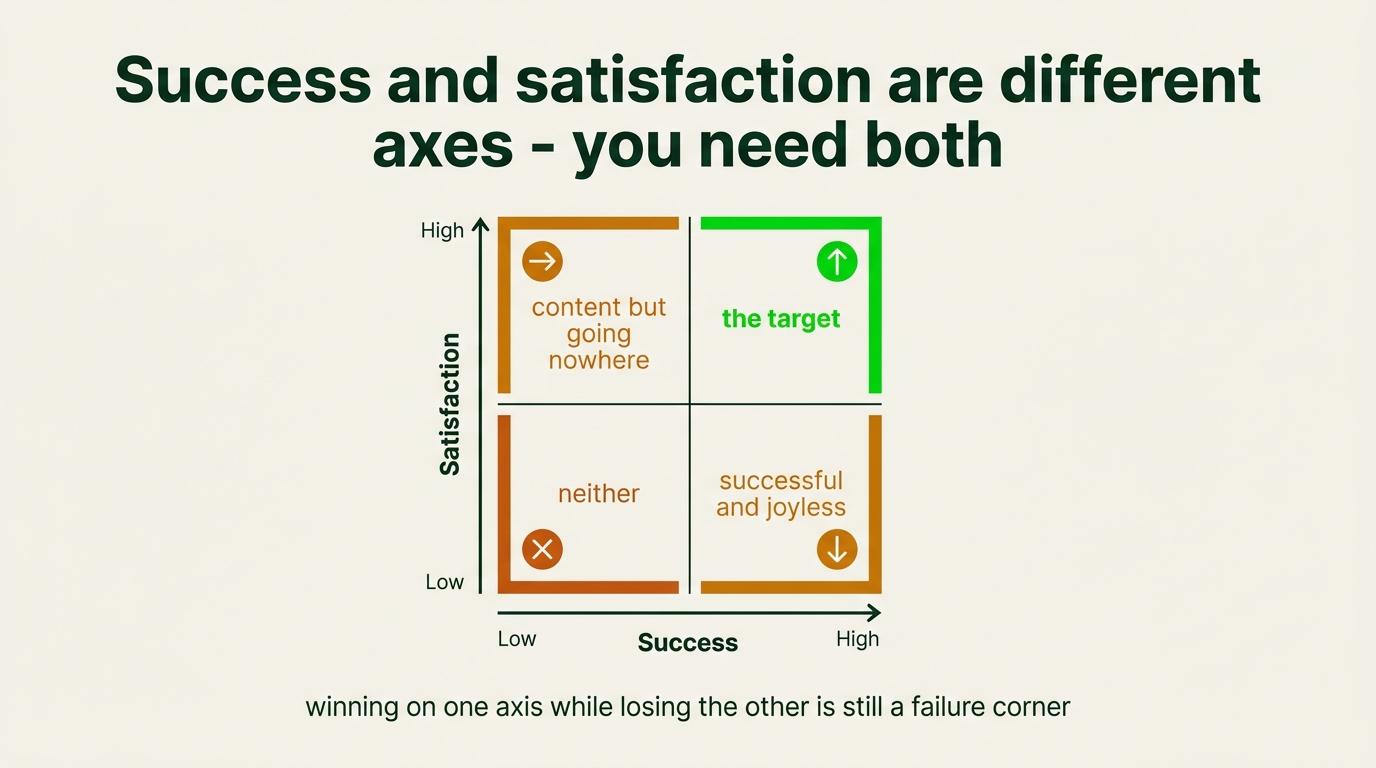
APPENDICES
Reference material. Available when needed, no longer interrupting the argument.
Appendix A: Sources and intellectual lineage
Where the ideas came from
Most of what is underneath this system I learned from books, coaches, operators and entrepreneurs, and almost none of the underlying ideas are original to me.
Assume anything genuinely intelligent in here came from somewhere else. What belongs to this document is the sequencing, the specific implementation, the failures, and the corrections.
One warning about attribution generally, since this industry has a problem with it. Historians have a name for the way good quotes migrate to famous people, because Churchill accumulated a great many things he never said.
Online business has its own version, where a large share of the field's ideas end up attributed to whoever is most visible this year regardless of who actually originated them.
So I have tried not to attribute anything I have not verified. Where I know the source, it is named. Where I picked something up and cannot trace it, I say that instead of guessing, and where a phrase is in common circulation I use it without pretending to know who said it first.
What this is built on
None of the underlying ideas here are mine. What is mine is the specific implementation and the several years of getting it wrong in ways I have documented rather than deleted.
If you want to go deeper on the reasoning underneath any part of this, these are the sources it leans on hardest.
| Atomic Habits, James Clear | Layer 5. Systems over goals, identity votes, the Four Laws, and the compounding argument. The habit module is a specific implementation of this book |
|---|---|
| Beyond Freedom and Dignity, B. F. Skinner | The opening line of this document is close to a paraphrase of Skinner's central claim, which is that behavior is produced by environment rather than by autonomous inner character. Parts 1 and 3 are that argument applied to a working day. His Science and Human Behavior is the more systematic treatment if you want the mechanism rather than the philosophy, and it is where the reinforcement thinking behind the stakes mechanism comes from |
| Essentialism, Greg McKeown | Part 2. Subtraction as the operation rather than addition, and the discipline of deciding what does not get done |
| Deep Work, Cal Newport | Parts 1 and 3. Attention as a finite resource, and designing an environment that protects it rather than relying on wanting it enough |
| Four Thousand Weeks, Oliver Burkeman | Part 8. Load has a ceiling, and most productivity advice fails because it treats finitude as a problem to be solved rather than a condition to be worked inside |
Read them all in that order if you’re a nerd like me, though the honest answer is that Atomic Habits and Skinner cover most of the ground and the other three sharpen specific parts.
What this document adds is the sequencing, the failures, and the implementation detail. The ideas are borrowed. The order they go in, and the account of what happened when I ran them, is the part worth your time.
Appendix B: Live validation log
Current live validation
I am running the complete Operator's Reset system for 90 days, beginning August 20, 2026.
This is not a prescribed 90-day installation period. The core system installs far faster than that, and the timing section in the Closing has the real figure.
The 90 days exist to test what happens after installation. What survives real life, what needs refinement, what breaks, what compounds, and what looks different after sustained use rather than after a good week.
| Run started | August 20, 2026 |
|---|---|
| Day 30 update | PENDING |
| Day 60 update | PENDING |
| Day 90 update | PENDING |
| Last updated | [DATE] |
I have not mastered productivity and come down from a mountain with five perfect documents. These are principles and systems and lessons accumulated over years, mostly in fragments and mostly out of order. What is new is that I am running the complete integrated system deliberately and writing down what happens.
If you are working through this at the same time, ask me about it in Slack as you go. The updates at each checkpoint will carry the actual data, including the parts that did not work.
Proof of progression rather than proof of mastery. Those are different claims and only one of them is honest.
What each checkpoint records
The same fields every time, so the periods are comparable.
Consistency of the data map matters more than volume, and fifty vanity metrics would defeat the purpose.
Habitify adherence and patterns. Toggl allocation. Rize focus and context-switching, if running. Instrumentation failures. Major changes made to the system. What looked good in theory and failed in practice. Qualitative operating state. The biggest lesson of the period.
Appendix C: Current implementation stack
The architecture, in one glance
| OPTIONAL - ClickUp | Work execution, and optional personal task and project management |
|---|---|
| Toggl | Intentional macro time allocation. Where did I mean to put my time |
| Rize | Optional micro telemetry. What was actually happening on the computer underneath that |
| Approved configuration | The durable behavioral definition for the habit layer. What gets read on a rebuild |
| Habitify | Recurring behavior and completion. Did I do the things I committed to |
| Habitify calendar sync | The downstream visual schedule for those habits |
| Google Calendar busy guardrails | Booking protection, on the account hosting the booking page. Separate from the habits, and not a second definition |
| AI jobs + Command OS, later | Intelligence across all of it. Reads the streams, compares them, notices drift. Read and display only for the habit layer |
The tools will change. The jobs those layers perform are the durable part, and most of what went wrong in earlier versions of this system came from one layer being asked to do two of those jobs at once.
This is a living system, and the layers move at different speeds
Two things in this document change at completely different rates, and confusing them is the fastest way to misread it.
The principles move slowly. Focus is finite. Subtraction beats addition. Environment beats willpower. Direction precedes effort. Measurement precedes change. Habits come last. Load has a ceiling. I have not reversed one of those in years of running this and I do not expect to.
The implementations move constantly. Which app holds the habits, which tracker measures the time, which blocker sits on the browser, whether there is telemetry running underneath any of it. Most of those have changed at least once, and one of them changed while this document was being rewritten.
So this separates three things everywhere it can.
| The required outcome | What has to be true when you are done. Not negotiable, and not tied to any product |
|---|---|
| The recommended implementation | The current default. What I would set somebody up with today, and what I expect to be replaced eventually |
| My personal implementation | What I actually run, including the parts that are specific to me and would be wrong for you |
Read the outcome as the requirement and the rest as evidence. You may not use ClickUp. You may not want telemetry. You may not have a sauna or a coworking space or the same blockers I do. None of that matters if the outcome holds.
Where I have reversed a position, the reversal is in the document rather than edited out of it. What I believed, why, what running it actually produced, and what I do now. That evolution is the most useful part of any operating system and it is the first thing most documentation deletes.