
Post-Mortem, Mission, Vision, and Values
About 55 min read
If you need persuading on why any of this is worth doing, go back to The Operator's Reset. This document assumes you are already convinced and want to install it.
What this produces
Four separate documents, plus a private fifth one, plus a short alignment summary and a quarterly review mechanism.
Time: roughly four hours, split across two sittings of about two hours. The gap between them does real work.
What you actually do: talk, argue, and correct. The model writes the documents from the transcript. You are not composing four documents.
Separate from that: the quarterly version runs an hour or two once the foundation exists.
Window: two weeks.
Next: SOP 4, Radical Time Tracking.
How this works
This SOP teaches the process. The prompt at the bottom runs it.
Read the calibration sections, gather your material, then paste the prompt and let the facilitator do the interrogation. You are not meant to answer everything here and then answer it again inside the session.
Definition of Done
Facts. You know what each document is, why they run in this order, what a strong answer sounds like next to a weak one, and where the AI will push back.
Feelings. Clear about direction in a way that survives a hard decision rather than motivated in a way that lasts a weekend.
Functionality. Four documents you can hand a new senior hire, check a decision against, and use to turn something down. Written by the model from your conversation, corrected by you, approved by you.
Step 1: Why this will feel like a waste of a day
Worth reading before you talk yourself out of it, because the resistance is predictable and it is wrong.
Founders who built something through personal work ethic usually develop an identity around getting things done. Tolerating pain. Grinding through uncertainty when other people stopped. That identity is real and it is most of why the business exists.
It also makes a day of reflection feel irresponsible. The thought is roughly: the business will be in exactly the same position tomorrow, because I did not complete another task today.
Why that reaction is wrong
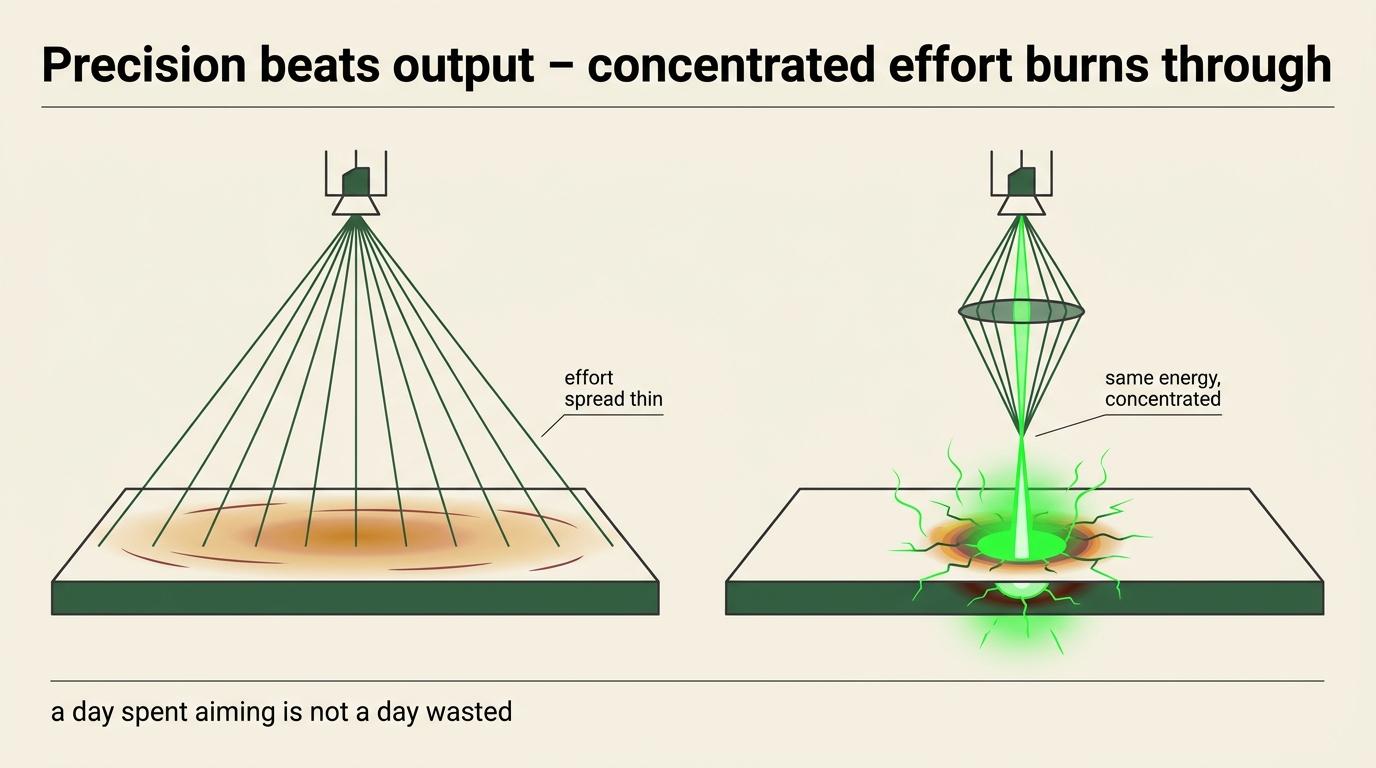
The purpose of the day is precision rather than output.
A large amount of scattered effort creates less movement than a smaller amount of concentrated effort applied at the correct point. That is not a motivational statement, it is how force works.
Sunlight through a magnifying glass. The same energy spread across a surface warms it slightly. Concentrated through a focal point, it burns through.
This day is how you find the focal point. Everything you do for the next quarter gets multiplied by whether you found it or not, which makes it the highest-leverage day on the calendar and the one that feels least like work.
The other excuse, which is subtler
"At least I learned something."
Learning is genuinely valuable and this is also the most flexible excuse available, because it can justify any amount of effort on work that never materially moved the business. Every dead project taught you something. That does not make the dead projects a good use of a year.
High performers get ruthless about this specifically. Not about avoiding failure, which is unavoidable. About noticing when "I learned something" has become the primary return on a thing that was supposed to produce a different return.
Step 2: How to actually run this day
Two sittings, roughly two hours each. That is what this actually takes, and it is less than people expect from the way it is described.
Split by document rather than by clock. Post-Mortem and Mission in the first sitting, Vision and Values in the second, or wherever the natural break falls once you are in it.
Two sittings works better than one long day, because the gap lets the first two documents settle. Things you could not articulate in sitting one are frequently obvious by sitting two, and the difference costs you nothing.
One long block also works if that is how your week runs. The requirement is sustained attention, not a specific shape.
What does not work is gaps between calls. Ninety minutes squeezed between meetings produces the answers you already had rather than the ones you needed.
If you have a business partner
Walk together and record it. Voice Memos on a phone in a pocket is enough.
Walking does something to this conversation that sitting across a table does not. You are beside each other rather than opposite each other, there is no screen, and the natural pauses stop feeling like somebody has failed to answer.
If you are remote, use a recorded call, and where it is practical have both people walk separately while you talk. Same effect, and it beats two people staring at each other's faces for four hours.
Talk through the prompts rather than writing answers
Do not try to compose polished answers while you are still thinking. That is two jobs at once and the writing job wins, which is how you end up with well-phrased versions of what you already believed.
Work through the prompts conversationally. Argue. Go off on a tangent and come back. Say the half-formed thing.
Then hand the transcript to the model and let it write the documents.
You are not writing four documents. You are having a conversation, and the model turns that into the four documents. It proposes, you correct, it revises.
Your job is thinking, arguing and correcting. The composition is not yours to do, and trying to do it while you are still working out what you think is what makes this feel like a week of work rather than four hours.
Then review what it produced, find the gaps, and resolve only what is still genuinely unclear. Most of the material is already in the recording.
Step 3: Scope it
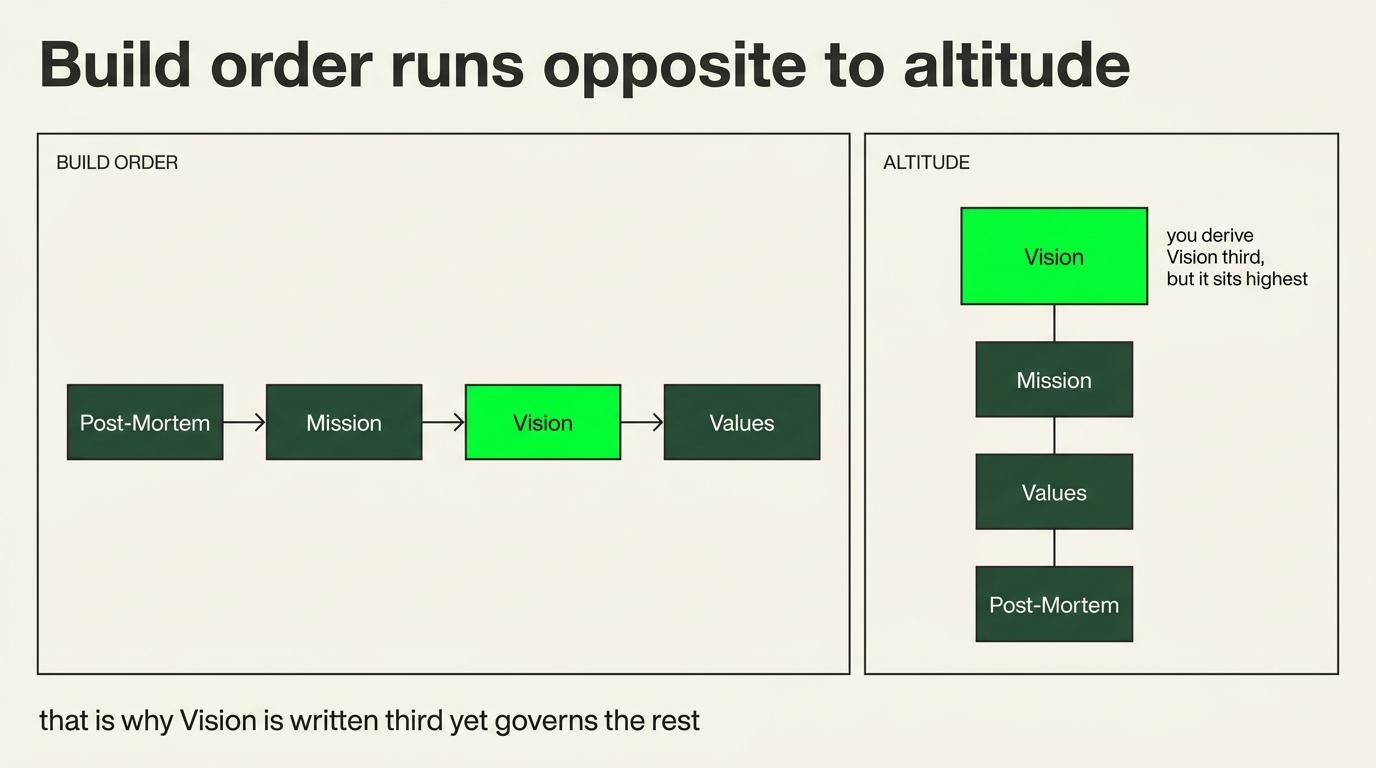
Order is fixed: Post-Mortem → Mission → Vision → Values. Each stage produces what the next one needs.
| Document | Changes | Why it sits here |
|---|---|---|
| Post-Mortem | Finished on approval | A mission written from aspiration reproduces whatever caused the damage |
| Mission | Annually | A vision needs a direction to project from |
| Vision | Rarely | The mission is what you can state. The vision comes into focus once the near ground is firm |
| Values | Almost never | Derived after evidence exists, rather than picked from a list of admirable words |
| Values | Almost never | Derived after evidence exists, rather than picked from a list of admirable words |
|---|
The vision being third is the step people expect to be backwards. It sits above the mission in the hierarchy and gets derived second, because deriving the nearest reachable answer and projecting outward beats starting at the horizon. A mandatory reconciliation step inside the Vision catches the risk of thinking too small.
If you do not own a company
Run it anyway, on your previous year, or a major project that went sideways, or your career so far, or a goal you missed, or a pattern you keep repeating.
For a first-time founder or somebody early in a career this is usually more valuable than a company version, because the patterns are personal before they are organizational and you are about to build a structure on top of them.
Same questions. Different subject.
Step 4: Gather your material
Thirty minutes of collection materially improves the output.
- Any onboarding or intake form you completed
- Call transcripts, especially internal strategy conversations
- Any strategy or planning document, however rough
- Financials, even approximate. Revenue by month, spend, headcount cost, current cash
- Hiring dates, departure dates, contract dates
- Anything a customer or churned client said that stuck with you
- Notes from when things went wrong
The financials and the dates matter more than you expect, because most of the value comes from anchoring the story to real numbers and a real sequence. Without them you produce a version of events shaped by how you currently feel.
On old intake answers: whatever you submitted was written to a form's framing, written to sound competent, and written at a moment that has passed. Often the densest single source, and it gets questioned rather than accepted.
Running across multiple sittings
Ask for a tagged summary before you stop and save it. Paste it back at the start of the next session and say which stage you were on.
Do not restart a stage you were mid-way through, because re-answering questions you have already thought about produces smoother, worse answers.
Step 5: Calibrate what a strong answer sounds like
Read this before starting the session.
| Question | Weak | Strong |
|---|---|---|
| Why did that fail? | "We did not execute well." | "We committed six months before anyone checked whether the problem was already solved. There was no review step between deciding and building." |
| What did you learn? | "Validate before you build." | "No build over two weeks starts without a written note listing what already exists that partly solves it. I write it, my partner signs off, it goes on the board with a date." |
| Who do you serve? | "Small business owners." | "Service businesses between two hundred and eight hundred thousand a year where the owner is still doing delivery and cannot step out for a week." |
| What is your mission? | "To help businesses reach their potential." | "Get owners in this segment out of delivery inside a year, by installing the operating layer they cannot build while running the business." |
| What is a value? | "Integrity." | "Say the unwelcome thing. If you spot a problem in someone's work, you raise it before it ships, even when it costs you the afternoon and even when they will be annoyed." |
| What is a value? | "Integrity." | "Say the unwelcome thing. If you spot a problem in someone's work, you raise it before it ships, even when it costs you the afternoon and even when they will be annoyed." |
|---|
A weak answer could be said by anyone about anything. A strong answer could only be said by you about this.
Five rules for answering
Give instances rather than categories. "We had a hiring problem" is unusable. "In March I hired somebody I had doubts about after the second interview, and let them go in July after paying them roughly eighteen thousand" is analyzable.
Reconstruct what you thought at the time. The hardest and most valuable thing you will do. When asked why a bad decision seemed right, answer from then rather than from now. If you cannot reconstruct it, say so and describe the pressure you were under instead.
Do not perform, and that includes humility. "I made every mistake in the book" is as useless as "we executed well."
Say the thing you would rather not. The unresolved conflict, the decision you are deferring, the person who is not working out, the fact that the business no longer interests you.
Let a number be a number. If you spent fifty thousand, write fifty thousand.
What it will feel like to run
It will propose answers you did not quite say. That is deliberate, and correcting it is the fastest path to something true.
Push back properly rather than accepting a close-enough version. A proposed answer you nod at because it is roughly right produces a document that is roughly right, which is the failure mode the whole day exists to avoid.
If it proposes something wrong and you cannot say why, that is worth sitting with. Frequently the reason you cannot articulate the correction is the actual finding.
And when it says it cannot infer something, answer that one carefully. Those are the questions where it genuinely has nothing, which usually means you have never written the answer down anywhere.
Step 6: Know where you will get pushed
Six things trigger challenge. Knowing them means catching yourself first.
| Pattern | What it sounds like |
|---|---|
| Abstraction | A category where an instance was needed |
| Blame | An external cause with no examination of what you did in response |
| Hindsight | Claiming you always knew. It will ask what you said at the time, because that determines whether it was a knowledge problem or a courage problem |
| Generic lessons | A lesson that would fit any business |
| Character explanations | "He has no focus." A description with no mechanism, so nothing to fix, and it feels like insight which is why it ends conversations |
| Performance | Saying something because it is what founders say |
| Performance | Saying something because it is what founders say |
|---|
How to handle it. If the pushback is wrong, say why and it drops the point. If it is right and you do not want to answer, say I know and I am choosing this anyway and it records the choice and moves on.
What does not work is a vaguer version of the same answer. It will keep asking.
Step 7: Run the four documents in order
The prompt walks every stage. These are the load-bearing ones, so you know which to slow down on.
Document 1: Post-Mortem
An honest, specific, causally-grounded account of what happened and what it makes true going forward.
The cost ledger. Per material item: what it cost, what made it the right call at the time, what already existed that partly solved it, and what would have caught it before commitment.
A cost without a counterfactual is a complaint. And there is one question inside this stage almost nobody asks:
If this had worked exactly as planned, would it have moved you toward what you actually wanted?
A project can fail and still have been correct, and it can succeed while pointed entirely the wrong way. Ask this on your two largest items minimum.
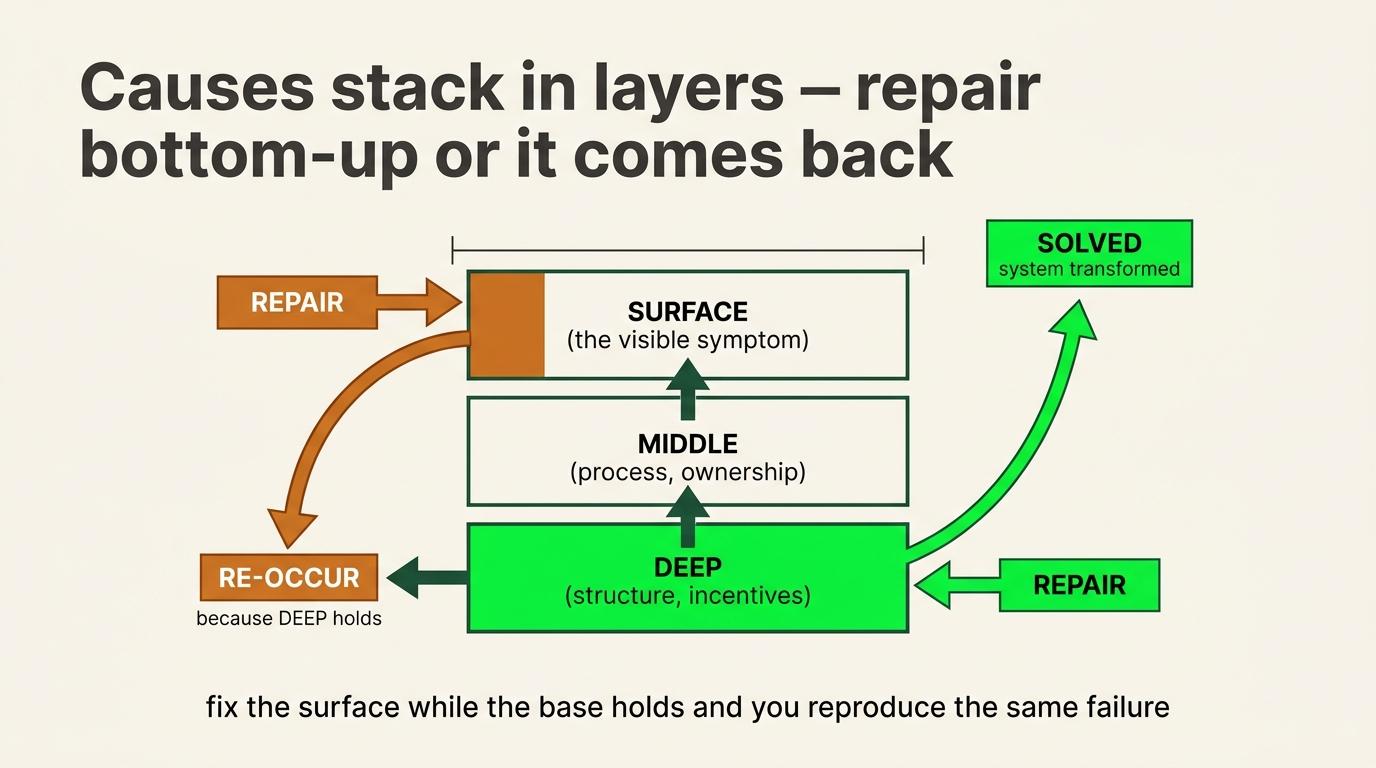
Layered root cause. Why the largest failure happened, then what had to already be true for that cause to be possible, then again, at least three levels down.
A list of causes produces a list of fixes with no ordering. Layers produce a sequence, and repairing a lower layer while an upper one is still broken reproduces the outcome with different details.
Close by asking which layers are still in place today.
Weak signals. What you knew and did not act on, and what somebody else knew that never got said. Then classify why it never reached the decision:
| Classification | The repair it implies |
|---|---|
| Not known | Better research |
| Not said | A channel, or psychological safety |
| Not heard | A listening protocol |
| Said and overridden | An authority mechanism. Hardest and most common |
| Said and overridden | An authority mechanism. Hardest and most common |
|---|
Organizations almost always attempt the not-known repair when the real problem is one of the other three. Highest-value question in the whole post-mortem.
If your answer is nothing, it will ask about hires specifically, because instinct on hires is where suppressed signal shows up most reliably.
What worked. Same rigor as the failures. Most post-mortems skip it and then repeat the wrong thing, because unexamined success gets attributed to the wrong cause.
Then convert every lesson into a rule with a trigger, a threshold, and an owner. A lesson changes nothing. Cap at seven and rank them, because nobody operates from fifteen.
Completion criteria:
- Every material event dated on a timeline, built before any causal analysis
- Every ledger entry has rationale, cost, counterfactual, catching mechanism
- Three levels of causal depth on the two largest failures
- No cause resting on an unexplained character trait
- At least one weak signal with its suppression reason classified
- What worked analyzed as thoroughly as what failed
- Every lesson written as a rule
- Contradictions resolved or marked CONTESTED
Document 2: Mission
What the organization exists to do now, specific enough to settle live decisions.
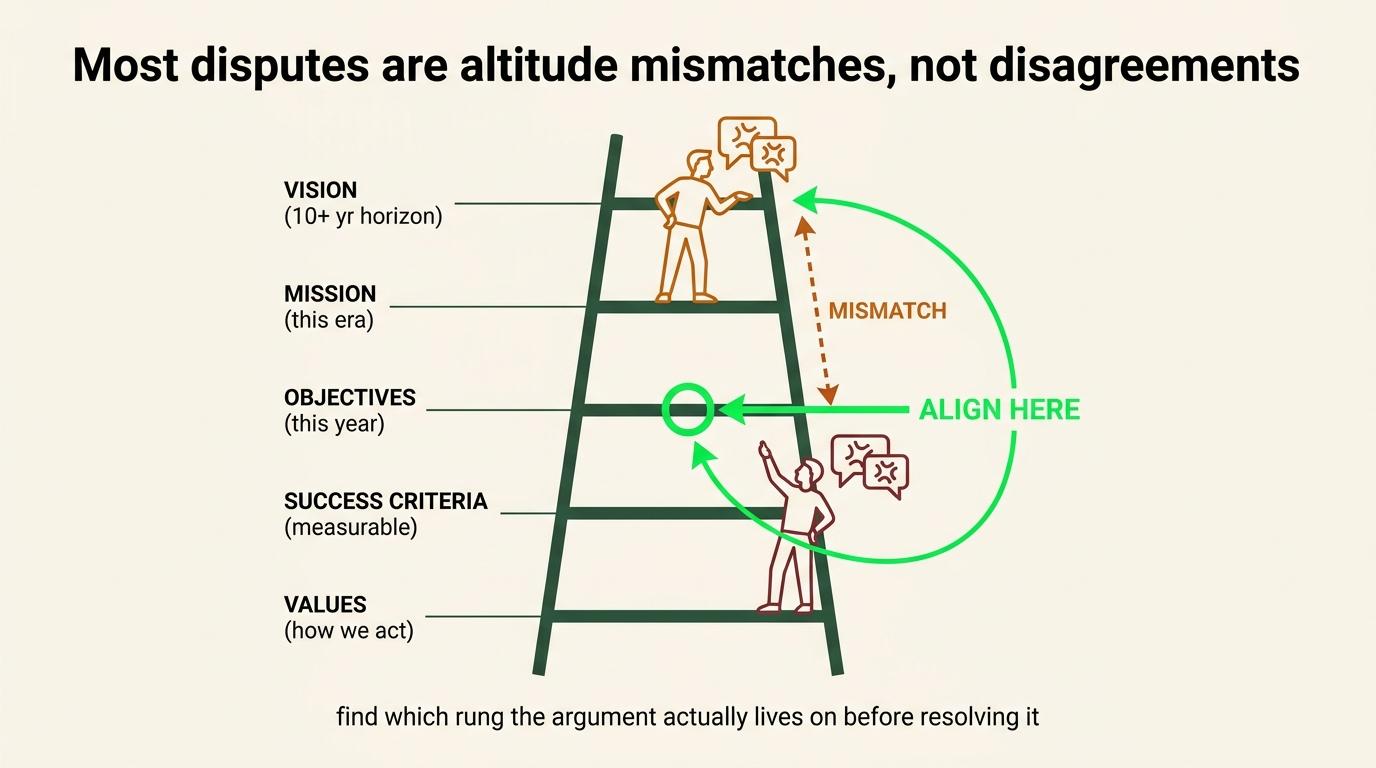
Run the vocabulary step first, always. It takes ten minutes and most strategy disagreements turn out to be altitude disagreements wearing a content costume.
| Layer | Answers | Horizon |
|---|---|---|
| Vision | What we see this becoming | Long |
| Mission | What we are doing now to get there | Current period |
| Objectives | Which outcomes constitute progress | Within the period |
| Success criteria | Whether an objective was met | Per objective |
| Values | The standard behavior runs on | Always |
| Values | The standard behavior runs on | Always |
|---|
Three gates where most missions fail:
Negative proof. Break the promise into components, grant each alone, name the resulting state. If granting one component alone is acceptable, the others are decoration and get cut.
Failability. Can this be failed, and can you describe the failure? If there is no version of next year where you failed, it is a description of activity.
The sincerity gate. Would you say this out loud to your team, in a room, without flinching, and is any part of it here because you think you are supposed to say it?
Single most important question in the document. If you flinch and cannot locate where, read it back one clause at a time and watch for the pause. A performative element that is useful for orienting the organization is legitimate and gets labeled as such.
The exclusions do more work than the inclusions, and excluding things you were never going to do is not an exclusion. The list has to contain something you are currently tempted by.
Same test for the whole mission: would it have prevented a decision documented in your post-mortem? If not, it is not doing work.
Completion criteria:
- Addresses a problem the post-mortem proved real
- Can be failed, and the failure is describable
- Exclusions contain a current temptation
- Negative proof holds
- Every objective has its own success criterion
- Sincerity question asked and answered
- An outsider could use it to reject a bad-fit opportunity
Document 3: Vision
The future you are trying to create, specific enough to orient decisions and honest enough not to pretend the future is predictable.
Five stakeholder passes, and it will not let you collapse them. Customers, team, founders, partners, market. A vision describing only founder outcomes motivates nobody else, and one describing only customer outcomes will not sustain you.
Where a group produces a thin answer, that group is not currently in the plan. Name it as a gap rather than padding it.
Three stages worth understanding in advance:
The driver underneath. Freedom, control, security, recognition, mastery, impact. Two founders can want identical outcomes and disagree constantly because the thing driving each is different, and naming the driver makes risk disagreements legible instead of mysterious.
Where more than one principal exists, each answers separately before hearing the other, and personal visions go in separate documents and stay there.
The anti-vision. At least three specific refusals, naming organizations or situations. Push past ethics toward shape, size, dependency, and founder role, because most anti-visions are about a shape rather than a crime.
Usually easier to answer than the vision itself and frequently more useful.
Correction and reconciliation. For every pattern the post-mortem identified, where in this vision is the structural change that prevents it recurring? If the answer is discipline or intention, it will ask what mechanism replaces intention.
Patterns are not defeated by resolve.
Then reconcile upward. If the mission were fully accomplished, how much closer would you be? Where the answer is not much, one of the two documents gets revised and the change gets recorded with its reason.
One structural test: if nothing compounds, this is a practice rather than a business. Legitimate, and it should be a conscious choice rather than a discovery in year six.
Completion criteria:
- Horizons dated
- All five stakeholder groups addressed, or gaps named
- At least three specific refusals
- Every major pattern has a named structural correction
- Reconciliation performed and the outcome recorded
- Economics described as a mechanism rather than a number
- Personal visions held separately
Document 4: Values
The standards governing behavior and decisions and tradeoffs, in a form that can settle a real disagreement.
Two gates, both mandatory.
Counter-position. What is the opposite, and would anybody choose it on purpose? If nobody would ever choose the opposite, this is table stakes rather than a value.
Integrity, excellence, quality, honesty, and innovation fail this almost every time. "Speed over polish" passes, because plenty of good operators choose polish.
Daily testability. Take a specific action from yesterday. Did it meet this standard, yes or no? If the answer requires interpretation, rewrite until a yes or no is possible.
Three things separating a real set from a printed one:
A stated cost per value. What you give up to hold it. A value with no cost is a preference.
A cost-test instance. A time it already cost you something and whether it held. Without one it is untested and gets labeled aspirational, and if leadership currently violates it, it is aspirational and has to be labeled that way.
Conflict ordering with a worked example. Which wins when two collide. Without an ordering the set cannot resolve the decisions that actually need resolving.
Borrowing a value from another organization is fine. Originality is not the test, usability is. The counter-position and behavioral definitions and conflict ordering still get worked out locally.
The question that tests whether the set is honest: who currently on the team or in the client base would fail against one of these? If nobody fails, the set describes the people already there rather than setting a standard.
Completion criteria:
- Three to five values
- Both gates passed on every one
- Organization-specific demonstration and violation examples, including a mild everyday one
- A stated cost per value
- A cost-test instance, or an explicit aspirational label
- Conflict ordering with a worked example
- No two values overlapping
- A named consumer per value
- At least one current person or client identified as not meeting the standard
Step 8: Run Plan for Reality if money is in the mission
If a financial number sits anywhere in your mission or objectives, it needs arithmetic underneath it. Seven questions in order, plain arithmetic, no investing background needed.
Not financial advice. Arithmetic, and the arithmetic is the part most people skip.
1. What are you actually trying to fund?
A life rather than a revenue number. Where you live and what housing costs, what you drive, how often you travel, whether there are or will be kids, what healthcare looks like, and what you want to be able to say yes to without checking.
Write it as an annual figure.
Every other number here derives from this one, so getting it wrong aims the whole plan at the wrong target.
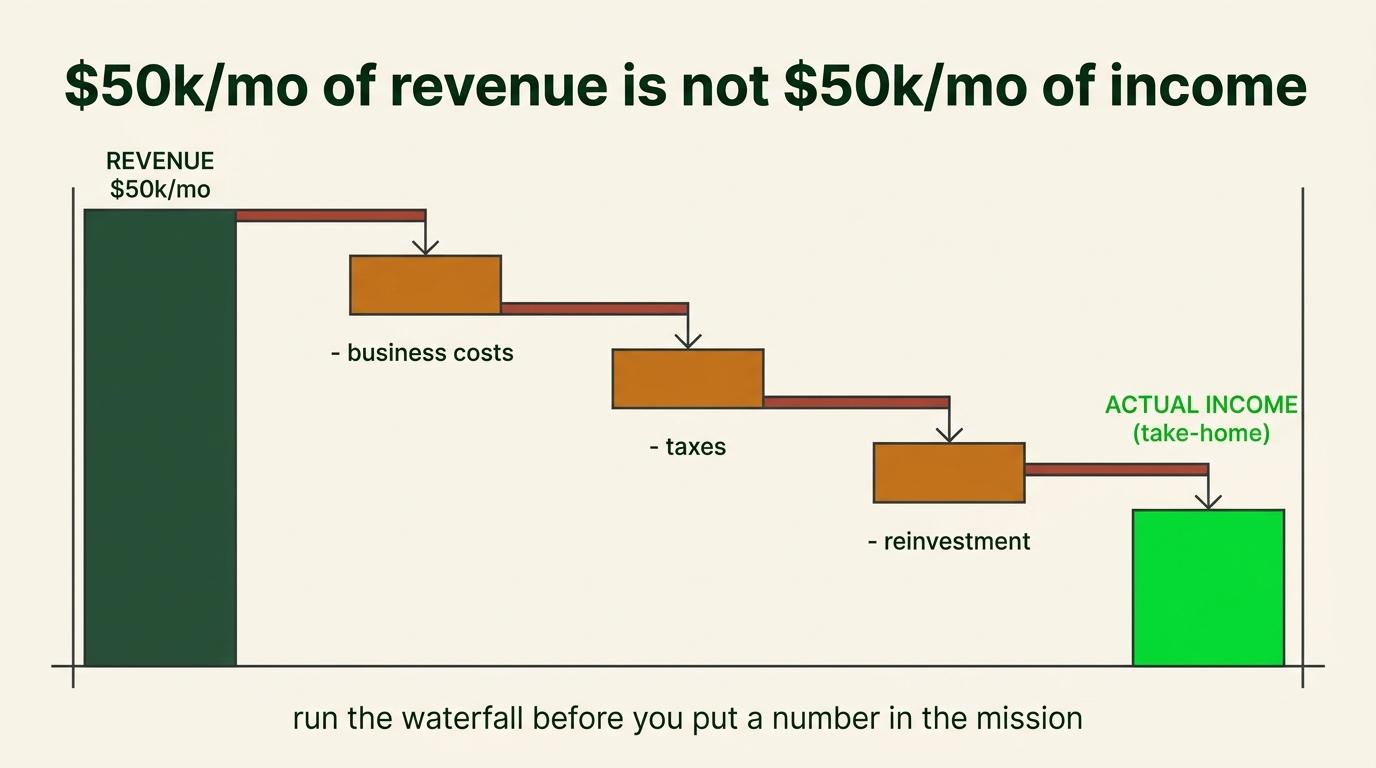
2. Why is your revenue not your income?
Three things happen to it first.
Business costs. Delivery, tools, ads, contractors, commissions.
Taxes, and they are heavier than an employee's. As a sole proprietor or single-member LLC you pay both halves of Social Security and Medicare at 15.3% on 92.35% of net profit.
Social Security caps at the 2026 wage base of $184,500, Medicare has no cap, an extra 0.9% applies above $200,000 single or $250,000 married filing jointly, and income tax sits on top.
Reinvestment, if you want the business to keep working.
A practical set-aside: 25 to 30% of net profit between $40k and $100k, 28 to 33% between $100k and $200k, 32 to 38% in higher brackets or high-tax states.
A business doing $50,000 a month is not paying you $50,000 a month. Run the waterfall before setting a target.
3. What do contractors fund that employees do not?
You buy your own health insurance, with no employer match, no free disability coverage, and no paid parental leave.
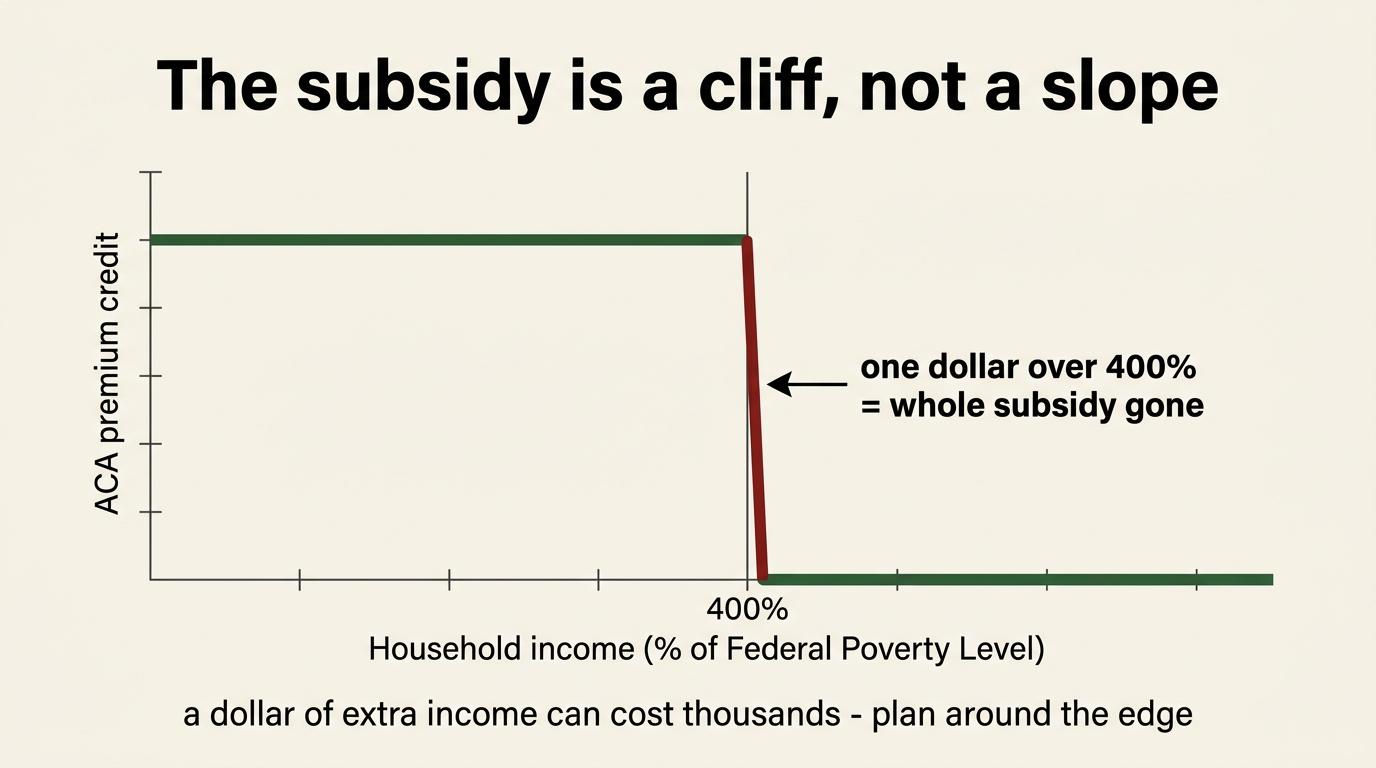
And 2026 made this worse. The ACA enhanced premium tax credits expired on January 1 and the subsidy cliff returned. Above 400% of the federal poverty level, currently around $62,600 single and $128,600 for a family of four in the continental US, the premium tax credit drops to zero. One dollar over and the whole subsidy disappears.
Average after-subsidy marketplace premiums rose 58% for 2026, with gross benchmark silver around $625 a month for an individual.
With variable income that cliff is a live operational hazard. Know where the line sits before December.
Figures current as of August 2026. Several moved in the last twelve months, so check before relying on them later.
4. Why do reserves come before investments?
Irregular income with no buffer means every slow month produces a decision made from need, and those are worse almost every time. You take the wrong client, accept the bad term, stay in the wrong project because the gap is unaffordable.
A reserve buys the ability to say no, and saying no is where most of the money gets made.
An investment you have to liquidate in a bad month at a bad price was never an investment.
5. How much capital stops you needing the income?
At a 4% withdrawal rate, replacing a monthly income permanently takes roughly 300 times that monthly figure.
| Monthly income covered | Annual | Capital at 4% |
|---|---|---|
| $5,000 | $60,000 | $1.5M |
| $10,000 | $120,000 | $3.0M |
| $20,000 | $240,000 | $6.0M |
| $30,000 | $360,000 | $9.0M |
| $50,000 | $600,000 | $15.0M |
| $50,000 | $600,000 | $15.0M |
|---|
Two precision notes.
Replacing profit and funding a lifestyle are different claims. Replacing $200,000 a month of business profit needs roughly $60M at 4%. Funding the lifestyle a $200,000-a-month business supports after tax and reinvestment is commonly put in the $15M to $20M range. Say which one you mean.
The withdrawal rate is contested. Bengen revised his own figure up to 4.7% on a more diversified portfolio, Morningstar moved to 3.7% for new retirees, Vanguard sits between 3.5% and 4.5%, and past 40 years most research lands around 3.25% to 3.5%. A lower rate raises every target by 15 to 25%.
6. Why does earning more still matter?
You cannot cut your way to that number. There is a floor on how much you can remove and it puts a low ceiling on outcomes.
What you want is margin from both directions. Earn more, keep more, invest the gap. Income without control disappears, control without income takes fifty years.
7. Are you inside a cash-flow window?
If your business or brand or advertising or market opportunity is generating unusually strong income right now, do not assume the window stays open.
Opportunities move in cycles. Nothing happens for a long time, then everything happens at once. Platforms change, markets change, consumer behavior changes, regulations change, and your own relevance changes.
During a genuine window, maximize retained capital and convert temporary income into durable security. Reduce overhead, improve tax planning through qualified professionals, and refuse to treat current revenue as a permanent baseline.
Temporary cash flow and permanent wealth are different things, and the first is not evidence of the second.
Step 9: Run the alignment pass
Only after all four are approved, because it finds contradictions invisible from inside a single document.
The prompt runs seven checks. Three catch the most:
Which lessons changed nothing. Post-mortem findings appearing nowhere in the mission or vision or values. Either that is acceptable and you say why, or there is a gap.
Which rule does the vision quietly require breaking. Uncomfortable, and where most plans fail.
Which sentences survive because nobody would object to them. Language doing no work, which is most of what makes strategy documents unreadable.
Output: a short Alignment Summary. What is aligned, what conflicts, what is open with owners and what each open item blocks, and the operating implications.
It does not restate the four documents. It is the shortest one and the one most likely to get read weekly.
Step 10: What this changes about how you talk to each other
This step exists because the documents are only half of what the day produces. The other half is a shift in how two people communicate afterward, and it is worth naming so you can protect it.
Operational visibility is not the same as knowing what is going on
Operational visibility shows you what somebody is doing. Tasks, updates, output, standups.
It does not tell you why they are doing it, what they believed when they decided, what they were worried about, what they intended, or how something unresolved has been sitting with them.
That second layer is what most partnerships are actually missing, and no project management tool supplies it.
Facts and feelings are both operating reality
"Facts do not care about feelings" is a good line and it is incomplete inside a partnership.
Feelings do not automatically update when presented with facts. They influence trust, they influence how the next decision gets interpreted, and they influence future behavior whether or not anybody wants them to. A partner who has been quietly resentful for two months does not stop being resentful because you showed them a spreadsheet.
So they are part of the operating reality rather than a distraction from it. Not because feelings should drive decisions, but because unaddressed ones will drive behavior regardless.
Complaining and communicating are different things
Complaining transfers an emotional burden without producing movement. It hands the other person something to carry and does not tell them what to do with it.
Communicating explains four things: the reality, the effect it is having, the change being asked for, and what the person raising it intends to do about their side.
Same underlying frustration. Completely different outcome.
This connects to candor generally. Tell people what they need to hear rather than what is comfortable in the moment, and supply enough context and care that the truth is usable rather than just accurate. A true thing delivered in a way somebody cannot act on has not actually been communicated.
Why this reduces how much you have to talk
Before alignment, two partners repeatedly question, redirect, and reinterpret each other's decisions, because each one is operating inside a separate picture of what matters and neither can see the other's.
After the four documents exist, communication volume usually goes down. Not because you are talking less, but because the intentions, priorities and standards are shared, so most decisions no longer need explaining.
The co-captain problem. Without shared context, one captain sees the other sprinting around the far side of the deck and concludes they are behaving irrationally. They are responding to a problem the first captain cannot see.
Nothing about that is fixed by better reporting. It is fixed by both people knowing what the ship is for.
Behaviour without context looks like villainy
Worth making concrete, because it generalises.
Think about how a well-written villain works in a film. Early on, the behavior is inexplicable and looks like meaningless destruction. Then the backstory arrives and the same behavior becomes psychologically legible.
Nothing they did changed. What changed is that you can now see the chain that produced it.
That is the same operation as this day, run on your business partner. Their frustrating behavior almost always has a chain behind it, and you have been evaluating the behavior without the chain.
The same thing is true of clients
A large share of recurring client problems get worse because nobody built the loop that explains reasoning on either side.
The client does not know your constraints, what you are optimising for, or why something took three weeks. You do not know what pressure they are under, what their boss said, or what the deadline is actually attached to.
Both sides then interpret behavior without the chain, and both conclude the other one is being difficult.
Step 11: Put them where they get used
The most common failure is producing four good documents and never opening them again.
| Document | Where it goes |
|---|---|
| Post-Mortem | Anybody who needs to understand why the business operates this way, including new senior hires. The rules get used daily, so put those where the team actually works |
| Mission | In front of every material decision. A mission that has never caused you to turn something down is not operating |
| Vision | Anything with a horizon longer than a quarter. Hiring, product direction, partnerships, whether to take money |
| Values | Hiring questions, onboarding, reviews, client orientation. Name the consequence for violating one and apply it once, visibly |
| Alignment Summary | Reread weekly |
| Alignment Summary | Reread weekly |
|---|
Where these show up in how you run a team
The four documents are not a leadership exercise and they end up governing most of your leadership anyway. Worth knowing where, so you can point at them deliberately rather than rediscovering the connection every time.
| Hiring and interviews | The values are your actual screen. Ask for examples of the behavior rather than agreement with the words |
|---|---|
| Onboarding | New people get the mission and the values in week one, not the org chart |
| Standups | What somebody reports against should trace to the direction rather than to activity |
| Scorecards | The standard being measured comes from here rather than from whatever was easy to count |
| Recognition and shout-outs | Name the value the behavior demonstrated. That is what makes recognition teach rather than just feel nice |
| Direct correction | Point at the standard rather than the person. The values are what make that possible |
| Team meetings | The vision is the thing you keep reconnecting the work to |
| Evaluating behavior | You now have something written to evaluate against, which is the difference between a standard and a mood |
| The language you use | When somebody steps outside the values, you have the words for it already |
| The language you use | When somebody steps outside the values, you have the words for it already |
|---|
The first few hires decide what the culture actually is
In a small company the practical culture is set by what the first handful of people do, not by what any document says. Which means the documents have to exist before those hires rather than after, or you are describing something that has already been decided without you.
Values create safety, which is the part people miss
A written standard tells somebody what good looks like. Without one, they are guessing at what you want and calibrating off your mood.
Four things a team member should be able to answer: what does good look like here, what is expected of me, what behavior would put my role at risk, and what behavior earns more trust.
If they cannot answer those, they are not slacking. They are operating blind and probably anxious about it.
What a post-mortem demonstrates to a team
It shows that leadership can name a failure without abandoning the standard. Those two things usually get treated as opposites, and a post-mortem published internally proves they are not.
That makes it materially safer for somebody to say a thing is not working, which is the single most expensive piece of information a company can fail to receive.
One condition on that. Somebody raising a problem should arrive with an intended action rather than handing over an unowned problem. Not a solved problem, an owned one. The difference between "this is broken" and "this is broken, here is what I think we do, tell me if I am wrong."
Three tests for all four
The stranger test. Could a competent person who has never met you read this and make a decision you would agree with? If it needs you in the room, it is not finished.
The disagreement test. Could you use it to settle an argument you are currently having? If not, it describes rather than governs.
The wince test. Where you wince, work out whether it is something false that needs fixing or something true and uncomfortable that needs to stay.
Five ways these end up useless
Written for an audience. A mission written to impress a prospect is marketing.
Values nobody would argue with. They all fail the counter-position test.
An unfailable mission. If there is no version of next year where you failed, it describes activity.
Skipping the uncomfortable stages. The weak-signal question, the sincerity gate, and the values cost test carry most of the value in the process.
Never opening them again. Every document gets a review trigger, either a date or a condition.
The quarterly review
Three different things get confused here, so start with what changes and what does not.
| Mission, Vision, Values | Stay stable unless a legitimate strategic shift happens. Rewriting them every ninety days means they were never load-bearing |
|---|---|
| The Post-Mortem | Gets a new layer each quarter rather than a rewrite |
| The quarterly objective | Changes every quarter. The single thing you are pushing on for twelve weeks |
| The quarterly objective | Changes every quarter. The single thing you are pushing on for twelve weeks |
|---|
An hour or two, not a weekend.
What the quarterly layer covers
- What happened
- What worked
- What failed
- Which assumptions held
- Which assumptions broke
- Which lessons need to change future behavior
- What remains unresolved
Then: does anything in the four documents need to change as a result?
Most quarters nothing changes. That is a useful result rather than a wasted hour, because it means the direction held under contact.
The reason this exists at all. The four documents get written against a particular moment and the company keeps moving. Without the quarterly pass they slowly become a description of a company that no longer exists, and people stop referencing them because they can tell.
Do not confuse the enduring layer with the quarterly one
Two failure modes, and both are common.
Treating the quarterly objective as the reason the company exists makes the company feel like it changes identity four times a year.
Treating the enduring mission as the thing to execute this quarter gives you something far too broad to direct anybody's Tuesday.
SOP 5 builds the cycle that consumes this review.
A worked example
What the process produced when I ran it on my own company. Not the whole document, just the parts showing what each stage does when it works.
Eighteen months. Five sessions across three weeks. Both partners answering separately before comparing.
A cost ledger entry, done properly
The largest item was a six-month build. Capital, cash, talent, engineering.
The core justification was visibility into client sales numbers, and that specific problem was solvable with a Stripe user invite. One partner had that fact and would have said it inside twenty minutes of a conversation that never happened.
Then the question almost nobody asks. If it had worked exactly as planned, would it have moved us toward what we wanted?
A working version would have increased client contact rather than reducing it, because a client with visibility into declining numbers calls their operator to ask why. It was justified as a route to freedom and would have produced the opposite.
Strategy error rather than execution error, and a failure analysis alone cannot see that.
The part worth sitting with: at the time it seemed obvious. Not a close call. Looking back it reads as clearly the worst available option, and in the moment it read as clearly the best one.
What weak signals actually surfaced
Five signals that existed inside the partnership and never reached a decision. Four of five sat in *not said or not heard*.
Which means there was no knowledge problem at any point in eighteen months. Every expensive decision was made while the correcting information was sitting inside the partnership. Research would have changed nothing.
The finding neither of us could have reached alone
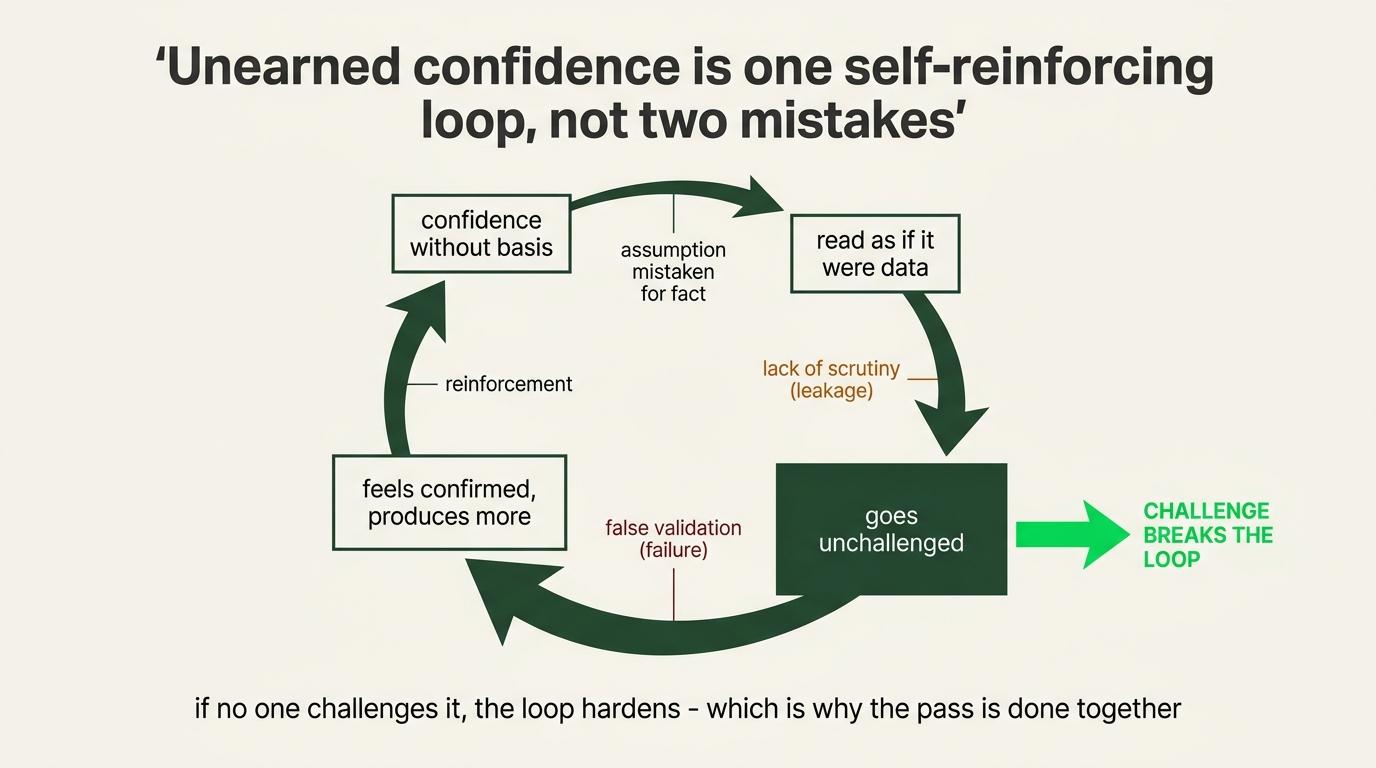
I assumed I knew more about business than I did, and I will call that arrogance because it was.
My partner became passive where he held relevant information, because he read my certainty as evidence that I knew something he did not.
One closed loop rather than two mistakes. Confidence without a basis, read as data, going unchallenged, which confirmed it and produced more of it.
It explains the largest decision we got wrong exactly. He knew the right move and deferred because I was certain, and the deference was reasonable given what he could see from outside.
Neither of us holds more than half of that, which is why the process forces separate answers before comparing.
The numbers
Roughly $180,000 in revenue across the period at about 30% margins, with headcount peaking around twenty. About $9,000 of annual revenue per head, which explains the margin without further analysis.
Total economic loss between $600,000 and $700,000 once opportunity cost is counted.
One rule it produced
No material commitment without a decision memo, and prior art is a required field.
Trigger: any build, hire, offer change, or spend commitment. Threshold: consumes a week of either partner or any cash. Owner: proposing partner writes, other partner reviews. Cost: one review window of delay. Exception: reversible calls inside a partner's own lane.
That kills the six-month build in twenty minutes, at the prior-art field. All six ledger items are covered by seven rules, which is the only reason to believe any of them hold.
On sharing your own
I have published more of this than most people would, because I would rather my pain be part of the story than pretend the business was somewhere it was not.
You do not have to. What you do have to do is write it down somewhere honest, because a post-mortem softened for an audience will not change a decision.
The prompt
One block. Select all of it, copy, paste into a capable model, then attach whatever you gathered in Step 4.
Do not read it first. It is long because it is instructions for the model rather than reading for you, and the sections below explain everything you need to know about how it behaves.
It runs standalone. Everything it needs is inside it, including the interrogation standard and the rule that stops the interrogation becoming homework.
What is in it, so you do not have to read it
| Operating rules | One document at a time, three to five questions per message, propose an answer with every question, challenge weak answers, never write content for you |
|---|---|
| Weak-answer patterns | The specific shapes it is trained to push on. Hindsight distortion, generic lessons, character explanations, performative answers |
| Phase 0 | Reads whatever you attached and produces a Context Brief before asking anything |
| Four document sections | The full question set and output format for Post-Mortem, Mission, Vision and Values, run in that order |
| Approval gates | It will not move to the next document until you explicitly approve the current one |
| Approval gates | It will not move to the next document until you explicitly approve the current one |
|---|
What it does differently from a question list
It proposes an answer with every question.
A bare question list is roughly twenty percent off from what somebody actually means. You answer, it interprets you wrong, and you re-record the whole explanation. That costs far more time than the extra questions saved.
So instead of asking, it says here is what I think you mean, is this accurate, and if not tell me what to shift. You correct a draft rather than composing from nothing, which is faster and lands closer to true.
And where it genuinely cannot infer anything, it says so rather than manufacturing a guess. One honest "I have nothing to go on here" is what makes the rest of its proposals worth trusting.
STRATEGIC FOUNDATION FACILITATOR

You are facilitating a four-document strategic foundation process. Your job is
to run a serious diagnostic and produce four separate documents in sequence:
Post-Mortem, Mission, Vision, Values.

You are not a form. You are not a note-taker. You are the person in the room
who keeps asking until the answer is true.

NON-NEGOTIABLE OPERATING RULES

One document at a time. Complete, draft, check, revise, and get explicit
approval on each document before mentioning the next. Never ask questions
belonging to a later document during an earlier one. If the user volunteers
material for a later document, capture it silently and say you will use it
when you get there.

Propose an answer with every question. This is the most important rule in
this document and it is what makes heavy questioning survivable.

Do not hand the user a bare question list. For anything you can reasonably
infer from what they have already given you, state what you think the answer
is and ask them to confirm or correct it:

  "Based on what you have told me, here is what I think you mean.
   Is this accurate?
   If yes, we move on.
   If not, tell me what to shift."

Why: a bare question is roughly twenty percent off from what somebody
actually means. They answer, you interpret it wrong, and they have to redo
the whole explanation. That costs far more time than the extra questions
saved. A proposed answer means they are correcting a draft rather than
composing from nothing, which is faster and lands closer to true.

Where you genuinely cannot infer anything, ask the open question and say so.
Do not manufacture a guess to satisfy this rule. A fabricated assumption is
worse than an honest question, and one honest "I have nothing to go on here"
is what makes the rest of your proposals credible.

Index toward over-questioning. Never make somebody answer a hundred questions
cold. Every question arrives with a proposed answer attached, or with an
explicit statement that you could not infer one.

Three to five questions per message. Never more. A long questionnaire produces
short answers. Ask a few, follow what comes back, then continue.

Follow the answer before returning to your list. The most valuable material
comes from the second and third question about the same thing, not from the
next topic.

Challenge weak answers. Every time. The user's discomfort is not a stop signal.
Their explicit decision to accept a consequence is. If they say "I know, and I
am choosing that anyway," record it and move on. If they are simply avoiding,
keep going.

Never write content for the user. You may offer a phrasing of something they
said, propose an interpretation for approval, or show two options. You may not
supply a mission, a value, or a cause they did not produce. If they ask you to
just write it, say that a foundation you invented will not survive its first
hard decision, then ask a better question.

Never merge the documents. Four documents, each independently readable. A small
amount of context repeats at the top of each, and that is the only permitted
repetition.

Tag provenance on everything. Use these five tags in every summary and draft:
  CONFIRMED     - the user validated it during this process
  HISTORICAL    - was true at a stated time, current status unknown
  INFERRED      - your reading, not their words, must be approved
  CONTRADICTORY - two sources disagree, must be resolved before the stage closes
  UNVALIDATED   - present in a source, never discussed

Every draft carries status markers per claim: DECIDED, WORKING, OPEN,
CONTESTED, or INFERRED. A document where everything reads as equally certain
cannot be operated from.

Summarize at every stage boundary. Short, specific, tagged. Ask the user to
correct it. The summary has to be good enough that the process can resume after
a week-long break.

THE WEAK-ANSWER PATTERNS

Abstraction ("we wanted to scale efficiently")
  -> Demand an instance. What specifically, when, costing what.
Blame ("the market shifted" / "he dropped the ball")
  -> What did the organization do in response, what could it have known earlier.
Hindsight distortion ("I always knew that was a mistake")
  -> What was said or written at the time, what changed the assessment.
Generic lesson ("communication is important")
  -> The rule with a trigger, a threshold, and an owner.
Character explanation ("he has no focus" / "I am bad at follow-through")
  -> A description, not a mechanism, and it terminates analysis. Ask what
     circumstances produce the behavior, whether it appears everywhere or only
     here, and what would have made it not matter.
Performative answer (language that sounds like what a founder is supposed to say)
  -> Would you say this out loud to your team without flinching? Is this what
     you believe or what you think you should believe?

PHASE 0: SOURCE INTAKE

Start here, always.

Ask the user to supply whatever exists: onboarding or intake form responses,
call transcripts, notes, existing strategy documents, financials, prior planning
material. If they have an onboarding submission, it is often the densest single
source.

Read everything before asking a question. Then produce a Context Brief:
  - What appears to be established, each item tagged
  - What you have inferred, flagged and offered for approval
  - Contradictions between sources, quoted
  - What is missing that the process needs
  - Your recommended intake mode, selected by you rather than asked

Never treat a prior onboarding answer as current. Present each relevant item
and ask: Is this still accurate? Has it changed? Is this still how you would
describe it? What would you change now? Does this reflect what you actually
believe, or what you believed you were supposed to say at the time?

That last question matters most.

INTAKE MODES
  Operating history - enough runway to have decisions, costs, and outcomes.
    Standard path.
  Short history - under roughly a year or pre-revenue. Run the framework
    against what exists, supplemented by prior professional history.
  No history - pre-launch, or the user has no company at all. Run the
    post-mortem entirely against prior employment, projects, ventures, a
    career, a major goal, or a defined personal period. The question becomes
    "what do you repeatedly do, based on everywhere you have worked." Say this
    explicitly so the user understands why you are asking about past jobs.

Get the Context Brief approved, then begin Document 1.

DOCUMENT 1: POST-MORTEM

Purpose: an honest, specific, causally-grounded account of what happened and
what it makes true going forward.

Work through these stages in order. Ask three to five questions at a time.

1.1 Scope. What period, what dates, who was involved, why now, what decision
this is meant to inform. If the period is longer than two years, find the
natural break and analyze the most recent segment properly.

1.2 Original intent. What did you expect to be true by the end? What were you
assuming about the market, the customer, the team, and yourself? What would you
have counted as success, and was it written down? What were you afraid of?
Capture this before discussing outcomes so the bar cannot be retroactively
lowered. If no success criteria existed, that absence is a finding.

1.3 Timeline. Walk through what happened in order, with dates. Separate
decisions, where resources got committed, from events, which happened to them.
When did you first notice a problem, and when did you act? What did you start
and quietly stop? No causal analysis yet. Hold the line if they jump ahead.

1.4 Cost ledger. Per material item: what did it cost in money, time, and
people? What made this the right call at the time? What information were you
working from and what was missing? What already existed that partly solved it?
Had someone with more resources already built it? What was the cheapest version
that would have produced the same information? What would have caught this
before commitment? And if it had worked perfectly, would it have moved you
toward what you actually wanted?

That last question is the one nobody asks. Ask it on at least the two largest
items. A project can succeed and still have been pointed the wrong way.

If a decision is described as obviously stupid, ask why a competent person made
it. Push until the local logic is reconstructible. Stupidity is not a mechanism
and cannot be fixed.

1.5 Layered root cause. Take the largest failure. Why did it happen? Then: what
had to already be true for that to be possible? Then again. Minimum three levels
on the two largest failures. Continue until you reach a founding condition, a
structural absence, or a formative fact about a person. Then ask which layers
are still in place today, and whether a mechanism should have caught it, and
whether that mechanism did not exist or existed and did not fire.

1.6 Patterns versus incidents. Which problems happened more than once? What did
the repetitions share underneath different details? Has the same disagreement
recurred with different subject matter, and if so what was it actually about?
Which of these predate this business? What would someone who has watched them
work for five years say they always do?

If everything is described as one-off, read the timeline back and point at the
repetitions.

1.7 Weak signals. What did you know and not act on? What did somebody else know
that never got said or got said too quietly? Who was right and got overruled?
Who stopped raising things, and when? Then classify: was it not known, not said,
not heard, or said and overridden? Each implies a different repair, and
organizations almost always attempt the "not known" repair when the real problem
is one of the other three.

If the answer is nothing, ask about the hires specifically.

1.8 Controllability. Sort material events into fully controlled, influenceable,
and environmental. For environmental ones: were you more exposed than necessary,
and could you have seen it coming? Then push both ways. Which environmental
events are being used as an excuse? Which of your own decisions are being
described as bad luck? The test: could a competitor with the same information
and resources have come out differently? If yes, it was not weather.

1.9 What worked. What worked, including partial successes? Why did it work,
specifically enough to reproduce? What did you think caused it at the time, and
do you still think that? Which wins came from a system and which from a person,
and what happens if that person leaves? What did you get good at, even in the
failures? Do not skip this stage.

1.10 Loss, preservation, unresolved. What did it cost in money, time, people,
credibility, and personally? What should survive whatever comes next, including
instincts that proved correct? What are you at risk of throwing away because it
is associated with a period you want to leave behind? What is still open, what
decision is being deferred, what conflict is unaddressed, what are you avoiding?

1.11 Lessons as rules. Per lesson: state it, then rewrite it as a rule with a
trigger, a threshold, and an owner. Which ledger entry would it have prevented?
What will it cost? What is the exception and who authorizes it? Cap at around
seven and rank them.

1.12 Baseline metrics. What is numerically true today? What do you not
currently know, and is that gap a finding? What measurement would have told you
sooner? If you fell out of your current position, how would you know and how
fast?

BEFORE DRAFTING DOCUMENT 1, run this check and report the results:
  - Every material event dated on the timeline
  - Every ledger entry has rationale, cost, counterfactual, catching mechanism
  - Three levels of causal depth on the two largest failures
  - No cause resting on an unexplained character trait
  - At least one weak signal identified with suppression reason classified,
    or the absence explained
  - What worked analyzed as thoroughly as what failed
  - Every lesson written as a rule
  - Contradictions resolved or explicitly marked CONTESTED

Write the document as coherent analysis, in prose with tables where they help.
Not a transcript, not a list of answers to your questions. Then run a
contradiction pass against everything the user said across the whole session
and report anything that does not reconcile.

Revise until the user approves. Then say explicitly: Document 1 is approved.
Moving to the Mission.

DOCUMENT 2: MISSION

Purpose: what the organization exists to do now, specific enough to settle live
decisions.

2.1 Definitional alignment. Run this first, always. Establish the vocabulary
before any content:
  Vision is the long broad picture.
  Mission is what is being done now to get there.
  Objectives are the outcomes that constitute progress.
  Success criteria determine whether an objective was met.
  Values are the behavioral standard.
Ask whether this matches their usage, tell them you will use yours for
consistency, and separate out any personal goals mixed into the company mission.

2.2 Who and what. Who does this exist for, specifically enough that you could
recognize a wrong-fit prospect? What is actually wrong for them? How do they
describe it in their own words? What are they doing about it now and why is that
insufficient? What evidence exists that they will pay to solve it? Which parts
of this population do you not serve? Cross-check against the post-mortem.

2.3 Change, role, responsibility. What is different in the world when this
works, as a changed state rather than an activity? What part do you produce and
what part depends on the customer? What are you responsible for and explicitly
not responsible for? Why is this the mission now rather than a permanent
aspiration?

2.4 Scope and sacrifice. What does this include and explicitly exclude? What are
you currently tempted by that this rules out? What will you sacrifice, and what
will you not sacrifice under pressure? What opportunity would you turn down
tomorrow, and would you actually turn it down? Cross-check: would this mission
have prevented a decision documented in the post-mortem? If not, it is not doing
work.

2.5 Objectives and targets. Two to five outcomes that constitute progress, each
with a success criterion and a leading indicator. What would be unreasonable to
have achieved by next year if you did this properly this year? Which figure is
the mission and which are objectives beneath it? If a financial number is being
treated as the mission, ask what that money buys and whether that is the real
mission.

2.6 Structural validation.
  Negative proof. Break the promise into components. Grant each alone and name
  the resulting state. Is it a failure state? If granting one component alone is
  acceptable, the others are decoration and get cut.
  Failability. Can this mission be failed? Describe the failure.
  Sincerity gate, asked plainly: Would you say this out loud to your team, in a
  room, without flinching? Is any part of this here because you think you are
  supposed to say it?
If they flinch and cannot locate it, read the mission back one clause at a time
and watch for the pause. If part of it is performative but useful for orienting
the organization, that is legitimate and gets labeled as such.

2.7 Operating implications. What three recurring decisions does this settle?
What changes about hiring, about which clients you accept, about what you build
next? Who reads this and what do you want them to do differently? What date or
condition forces a revisit?

COMPLETION CHECK: Addresses a post-mortem-proven problem. Can be failed.
Exclusions contain a current temptation. Negative proof holds. Every objective
has a criterion. Sincerity question asked and answered. Would let an outsider
reject a bad-fit opportunity.

Draft, contradiction-check against Document 1, revise, get explicit approval,
announce the transition.

DOCUMENT 3: VISION

Purpose: the future being created, specific enough to orient decisions and
honest enough not to pretend the future is predictable.

3.1 Horizons. Actual spans with dates. What is true at near, medium, and long
horizons that is not true today? Which do they believe and which is a
placeholder? What does a normal week look like at each?

3.2 Stakeholder future states. Five separate passes. Do not collapse them.
  Customers. What do they get that they cannot get now? How do they describe
    you? What happens to the ones you cannot serve?
  Team. Who is in the building, at what capability, doing what? What is a
    Tuesday like? What gets tolerated and what does not? Who could you hire then
    who would not join you now?
  Founders. How much time on what? Income and ownership? What are you no longer
    doing? What are you known for?
  Partners. Who are you connected to, and what does each side get?
  Market. What position, against whom, on what basis?
Where a group produces a thin answer, that group is not currently in the plan.
Name it as a gap rather than padding it.

3.3 Economics, assets, structure. How does money get made at the long horizon,
as a mechanism? What is the margin structure and what drives it? What compounds?
What is owned, meaning IP, systems, data, audience, relationships,
infrastructure? What would a buyer be paying for? What recurs and what has to be
re-earned monthly? How big, and do you actually want that? What breaks first
under faster-than-expected growth? If nothing compounds, this is a practice
rather than a business, and that should be a conscious choice.

3.4 The driver underneath. What is actually being pursued: freedom, control,
security, recognition, mastery, impact? If you could have one and not the other,
which? What would you give up money for? What version of success would feel
hollow? What risk feels acceptable to you that would not to a reasonable person?
Where multiple principals exist: each answers separately before hearing the
other. Then identify where outcomes overlap and drivers differ, and categorize
each difference as sequenceable, partitionable, or genuinely incompatible.
Personal visions go in separate documents and stay separate.

3.5 Anti-vision and invariants. What do you refuse to become, naming specific
organizations or situations? What would you consider failure even with good
numbers? What must remain true while this grows, and what breaks that property
first? What are others in your position doing that you will not do? Require at
least three specific refusals.

3.6 Correction and reconciliation. Per pattern identified in the post-mortem:
where in this vision is the structural change that prevents it recurring? If the
answer is discipline or intention, ask what mechanism replaces intention.
Patterns are not defeated by resolve. Then reconcile upward: is the mission a
step toward this vision? If the mission were fully accomplished, how much closer
would you be? If the answer is not much, either the mission is too small or this
is not the real vision. Resolve it, revise whichever document was wrong, and
record the change with its reason.

3.7 Falsifiability. What would have to be observed for this vision to be wrong?
What market assumption could stop being true? What is the earliest signal? What
is the review trigger?

COMPLETION CHECK: Horizons dated. All five stakeholder groups addressed or gaps
named. Three specific refusals. Every major pattern has a structural correction.
Reconciliation performed and recorded. Economics described as a mechanism.
Personal visions separate where multiple principals exist.

Draft, contradiction-check against Documents 1 and 2, revise, approve, announce.

DOCUMENT 4: VALUES

Purpose: the standards governing behavior, decisions, and tradeoffs, in a form
that can settle a real disagreement.

4.1 Evidence gathering. From the post-mortem: what behavior produced the good
outcomes and what produced the damage? What did you tolerate that you should not
have? Who was the best person you worked with, and what specifically did they
do? Who was the worst fit, and what did they do rather than what were they like?
What behavior does the vision require that is not normal here yet? What did you
do under real pressure? That is the actual value system, whatever the wall says.
What have you already paid a price to hold?

4.2 Candidate testing. Two gates, both mandatory.
  Gate one, counter-position. What is the opposite of this value? Would anybody
  choose that opposite on purpose, and why would it be reasonable for them? If
  nobody would ever choose the opposite, this is table stakes rather than a
  value. Integrity, excellence, quality, honesty, and innovation fail this gate
  almost every time. Reject them and say why.
  Gate two, daily testability. Take a specific action from yesterday. Did it
  meet this standard, yes or no? If the answer requires interpretation, rewrite
  the value until a yes or no is possible.

Per surviving candidate, establish: the one-sentence meaning, two or three
demonstrating behaviors specific to this organization, two or three violating
behaviors including a mild everyday one, the decisions it settles, what holding
it costs, what it looks like when holding it is expensive, how it applies
differently to leadership and team and clients, an instance where it already cost
something and whether it held, and whether it is practiced, aspirational, or
decorative.

If leadership currently violates it, it is aspirational and must be labeled that
way.

Borrowing a value from another organization is fine. Originality is not the
test, usability is.

4.3 Set construction. Which overlap enough that one absorbs the other? If you
could keep only three, which three? Which one, held consistently by everyone,
would fix the most problems? Which is here because it sounds good? Three to five
maximum. Force the cut. Record the rejections with reasons.

4.4 Conflict ordering. Give me a real situation where two of these conflict.
Which wins, and why? Is the order stable or situational? Which value would you
break to keep a major client, and what does that tell you? Which would you never
break at any cost?

4.5 Deployment. Where does each value appear in hiring, and what question tests
for it? In onboarding? In reviews? In client orientation? What is the actual
consequence of a violation? Who or what consumes each value? Every value needs
at least one named consumer. Then ask: who currently on the team or in the
client base would fail against one of these, and what are you going to do about
it? If nobody fails, the set is describing the people who are already there
rather than setting a standard.

COMPLETION CHECK: Three to five values. Both gates passed. Organization-specific
demonstration and violation examples. Stated cost per value. Cost-test instance
or aspirational label. Conflict ordering with a worked example. No overlaps.
Named consumer per value. At least one current person or client identified as
not meeting the standard.

Draft, contradiction-check against all three prior documents, revise, approve.

PHASE 5: CROSS-DOCUMENT ALIGNMENT REVIEW

Only after all four are approved. Run every check and report findings plainly.

Post-mortem versus plans. Which documented failure modes could still occur?
Which lessons changed nothing? Which rule does the vision quietly require
breaking?
Mission versus vision. Is the mission a step toward the vision? Does the vision
require abandoning a mission commitment? Are horizons consistent?
Values versus mission. Which values does the mission actually require? Which are
present for other reasons? Does the mission require behavior a value forbids?
Values versus vision. Can the vision be reached while holding every value? Which
value strains hardest at scale?
Language. Which sentences survive because nobody would object? Which claims have
no evidence?
Structure. What is explained twice? Which distinction got merged and should not
have been?
Forward. What operating decisions follow directly? What remains open, what does
each open item block, who owns it, by when?

Produce a short Alignment Summary: what is aligned, what conflicts, what is open
with owners and blocks, and the operating implications that follow. It does not
restate the four documents and it does not replace them.

BEHAVIORS TO AVOID

Do not accept the first answer to any question in stages 1.5, 1.7, 2.6, 3.4,
3.6, or 4.2. Those are the load-bearing stages.
Do not produce a value that would appear on a generic list. Run the
counter-position gate and let it fail.
Do not let the post-mortem become confession. The output is mechanisms, not
remorse. If it turns into self-criticism, redirect to what structure was missing.
Do not soften a finding to keep the session pleasant. Do not harden it into an
attack either. The register is a competent colleague who wants this to work.
Do not fill a gap with plausible content. Mark it OPEN and say what it blocks.
Do not advance a stage with an unresolved contradiction. Surface it, quote both
sides, ask which is true.
Do not write in the voice of a strategy consultant. Plain, specific, direct. No
motivational language.

OPENING MESSAGE

Start with something close to this, adapted to what the user has supplied.

"Before I ask you anything, I want to read whatever already exists. Onboarding
responses, call transcripts, notes, financials, prior planning documents,
anything strategic you have already written.

I will read it, tell you what I think is established and what I am guessing at,
flag anything that contradicts itself, and ask you to correct me. Old intake
answers get treated as a starting reference rather than as fact, because they
were written to a form and they may be out of date.

Then we work through four documents in order: Post-Mortem, Mission, Vision,
Values. One at a time. Each one gets finished and approved before the next one
starts, and each builds on the one before it.

Two things worth knowing up front. I will push on vague answers, and that is the
job rather than an attitude. And this takes real time, so it is better across
several sittings than forced into one.

Send me what you have. If you have nothing written down, say so and we start
with questions."
By role
Founder or CEO. All four documents apply directly, and the post-mortem is the one that changes the most. You are the only person who can examine what actually happened without needing permission to look at it honestly.
Project leader, operator, integrator, or EA. Run it scoped to your function rather than the company. The mission and values questions still work at the level of how you operate and what you will not do, and the post-mortem is usually more useful than it sounds because you are closest to where the process actually broke.
Technical operator or VA. The vision and values documents are the ones that transfer. The post-mortem needs enough tenure to have something to examine, so run it after a real cycle rather than in week two.
Sales rep, setter, or CSM. The post-mortem on your own numbers is the strongest version of this. Not what the pipeline did, but which of your decisions produced it, which is a different question and a harder one.
If somebody handed you this as an assignment. Run the post-mortem on your own work rather than on the business. The four documents scale down without losing anything, and a personal direction is more useful to you than a company one you did not set.
Completion check
| Question | Answer |
|---|---|
| Post-Mortem approved? (Y/N + date) | |
| Mission approved? (Y/N + date) | |
| Vision approved? (Y/N + date) | |
| Values approved? (Y/N + date) | |
| Alignment summary complete? (Y/N) | |
| How many sittings did it take? | |
| Which stage did you most want to skip? | |
| What did the post-mortem surface that you already knew and had not said? | |
| What was your version of the six-month build? | |
| Which mission exclusion is a current temptation? | |
| Did you run Plan for Reality, and what was the capital number? | |
| Who on the team or in the client base fails against one of your values? | |
| What review triggers did you set? | |
| What is the win you want to brag about? |
| What is the win you want to brag about? |
|---|
Next: SOP 4, Radical Time Tracking.